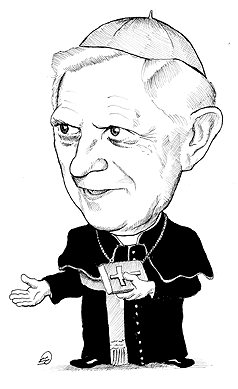
A Chronology of Notable Events in Cardinal Ratzinger's Life

(From his birth, to his service to the Church as priest and theologian, to his appointment as Prefect for the Congregation for the Doctrine of the Faith by Pope John Paul II).


See Also:

Special thanks to: Donald D. Hook, Ph.D., Professor emeritus, Trinity College, Hartford, CT. for his assistance in the composition of this biography.


1927
Ratzinger is born on April 16, Holy Saturday in Marktl am Inn, and is baptized the same day. Reflecting on this experience in his memoirs, he says:
To be the first person baptized with the new water was seen as a significant act of Providence. I have always been filled with thanksgiving for having had my life immersed in this way in the Easter Mystery . . . the more I reflect on it, the more this seems fitting for the nature of our human life: we are still waiting for Easter; we are not yet standing in the full light but walking toward it full of trust. [p. 8, Milestones]

Ratzinger admits it is not easy to say what his 'hometown' is. As a rural policeman, his father was transferred frequently, and his family was continually on the road.


1929
Ratzinger's family moves to Tittmoning, a small town on the Salzach River, on the Austrian border.

1932
December: Due to his father's outspoken criticism of the Nazis, Ratzinger's family is forced to relocate to Auschau am Inn, at the foot of the Alps.

1937
Ratzinger's father retires and his family moves to Hufschlag, outside the city of Traunstein, where Josef would spend most of his years as a teenager. Here he begins classes at the local gymnasium for classical languages, where he studies Latin and Greek.

1939
Ratzinger enters the minor seminary in Traunstein, the initial step of his ecclesiastical career.
Young Ratzinger

1943
Ratzinger, along with the rest of his seminary class, is drafted into the Flak [anti-aircraft corps]. He is still allowed to attend classes at the Maximilians-Gymnasium in Munich three days a week.

1944
September: Having reached military age, Ratzinger is released from the Flak and returns home, only to be drafted into labor detail under the infamous Austrian Legion ("fanatical ideologues who tyrannized us without respite").


November: Ratzinger undergoes basic training with the German infantry. Due to illness he finds himself exempt from most of the rigors of military duty.


1945
Spring (end of April or beginning of May): As the Allied front draws closer, Ratzinger deserts the army and heads home to Traunstein. When the Americans finally arrive at his village, they choose to establish their headquarters in the Ratzinger house. Josef is identified as a German soldier and incarcerated in a POW camp.

June 19: Ratzinger is released and returns home to Traunstein, followed by his brother Georg in July.

November: Ratzinger and his brother Georg re-enter the seminary.

1947
Ratzinger enters the Herzogliches Georgianum, a theological institute associated with the University of Munich.

1951
June 29: Georg and Josef Ratzinger are ordained into the priesthood by Cardinal Faulhaber, in the Cathedral at Freising, on the Feast of Saints Peter and Paul.

1953
July: Ratzinger receives his doctorate in theology from the University of Munich. In connection with his doctoral studies he produces his first important work: Volk und Haus Gottes in Augustins Lehre von der Kirche [People and House of God in Augustine's doctrine of the Church].

Ratzinger devotes his Habilitationsschrift -- book-length contribution to original research in order to teach at the university level -- to Bonaventure's theology of history and revelation.

1959
April 15: Ratzinger begins lectures as full professor (one holding a chair) of fundamental theology at the University of Bonn.

August 23: Ratzinger's father passes away.

1962-65
Ratzinger is present during all four sessions of the Second Vatican Council as a peritus, or chief theological advisor to Cardinal Josef Frings of Cologne, Germany.

1963
Ratzinger moves to the University of Münster.

Dec. 16: Ratzinger's mother passes away.

1966
Ratzinger takes a second chair in dogmatic theology at the University of Tübingen. His appointment is vigorously supported and secured by fellow professor Hans Küng. Ratzinger had initially met Küng in 1957 at a congress of dogmatic theologians in Innsbruck, after recently reviewing Küng's doctoral work on Karl Barth. Says Ratzinger:
I had many questions to ask of this book because, although its theological style was not my own, I had read it with pleasure and gained respect for its author, whose winning oppenness and straightforwardness I quite liked. A good personal relationship was thus established, even if soon after . . . a rather serious argument began between us about the theology of the council. [Milestones, p. 135]

1968
A wave of student uprisings sweeps across Europe, and Marxism quickly becomes the dominant intellectual system at Tübingen, indoctrinating not only his students but many of the faculty as well. Witnessing the subordination of religion to Marxist political ideology, Ratzinger observes:
There was an instrumentalization by ideologies that were tyrannical, brutal, and cruel. That experience made it clear to me that the abuse of faith had to be resisted precisely if one wanted to uphold the will of the Council [Salt of the Earth].

1969
Scandalized by his encounter with radical ideology at Tübingen, Ratzinger moves back to Bavaria to take a teaching position at the University of Regensburg. He eventually becomes dean and vice president and later, theological advisor to the German bishops.

Two of his most prominent students in these years was the Dominican Christoph Schönborn, who would later become editor of the Catechism of the Catholic Church and cardinal archbisohp of Vienna, and Fr. Joseph Fessio SJ, who would found Ignatius Press.


1972
Ratzinger, Hans Urs von Balthasar, Henry De Lubac and others launch the Catholic theological journal Communio, a quarterly review of Catholic theology and culture.

1977
On July 24, 1976, Cardinal Julius Dopfner of Munich dies. On March 24, 1977, Ratzinger is named Archbishop of Munich and Freising by Pope Paul IV. He is urged by his confessor to accept the office, and is consecrated May 28, the vigil of Pentacost. Ratzinger chooses as his episcopal motto the phrase from the third letter of John, "Co-Worker of the Truth," reasoning:
For one, it seemed to be the connection between my previous task as teacher and my new mission. Despite all the differences in modality, what is involved was and remains the same: to follow truth, to be at its service. And because in today's world the theme of truth has all but disappeared, because truth appears too great for man, and yet everything falls apart if there is no truth. [Milestones, p. 153].
June 27 - Ratzinger is elevated to Cardinal of Munich by Pope Paul VI.

1980
Ratzinger is named by Pope John Paul II to chair the special Synod on the Laity. Shortly after, the pope asks him to head the Congregation for Catholic Education. Ratzinger declines, feeling he shouldn't leave his post in Munich too soon.

1981
On November 25, Ratzinger accepts Pope John Paul II's invitation to take over as Prefect for the Congregation for the Doctrine of the Faith.

1986
On July 10, Pope John Paul II appointed Cardinal Ratzinger head of a 12-member commission responsible for drafting the Catechism of the Catholic Church. The text was released in French in 1992 and in English in 1994.

1998
On November 6, Ratzinger is elected vice dean of the College of Cardinals.

2002
On November 30, The Holy Father, Pope John Paul II, approved his election, by the order of cardinal bishops, as dean of the College of Cardinals.

2005
On April 19, Cardinal Ratzinger was elected Bishop of Rome, and took the name Benedict XVI.