Monday, April 18, 2005
Ratzinger Roundup!
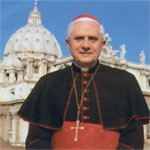 - Homily of the Dean of the College of Cardinals, Joseph Cardinal Ratzinger, at the Mass for the Election of the Roman Pontiff. April 18, 2005. Via Heart, Mind & Strength weblog.
- Cardinal Ratzinger 'odious' News24.com. April 18, 2005:
Sao Paulo - German Cardinal Joseph Ratzinger, considered a high possibility to become the next pope of the Roman Catholic Church, was branded "odious" on Sunday by Brazilian leftist theologist Leonardo Boff, who predicted Ratzinger would never become pope. . . ."Ratzinger is one of the (Catholic) church's most odious cardinals because of his rigidity, and because he humiliated the bishops' conferences and fellow cardinals in an authoritarian manner on questions of faith," Boff wrote in the newspaper O Estado. A former priest who was condemned to silence by Pope John Paul II in 1985 for supporting radical liberation theology, Boff said Ratzinger "will never be pope, because it would be excessive, something the intelligence of the cardinals would not permit". First Hans Kung and Matthew Fox, now Leonardo Boff . . . the media speculation over the papability of Cardinal Ratzinger presents an opportunity for every heterodox theologian "silenced" by the Congregation of the Doctrine of the Faith to reassert themselves and grab their 15 minutes of fame.
- Ratzinger a Nazi? Don't believe it, by Sam Ser. Jerusalem Post April 18, 2005. A Jewish newspaper promptly dismisses the scurrilous charges of Ratzinger's 'Hitler Youth': "not even Yad Vashem has considered it worthy of further investigation. Why should we?" -- While we can't Don't expect the rabid wolves of the press to roll over and give up that easily, let's thank the Jerusalem Post for their display of common sense.
- "Pope's 'enforcer' heads field as election begins", The Independent April 18, 2005. Peter Popham in Rome comes out swinging with some memorable labels:
The favourite to win is Joseph Ratzinger, 78, the late Pope's personal theologian, the massively orthodox heir to the Inquisition and "enforcer of the faith" who has been fighting to rid the church of all the "heretics" let in by the liberalism of the Vatican's Second Council.
"Massively orthodox"? -- As opposed to what? Skinny and malnourished?
Ratzinger and Ecumenism - Some quick thoughts
- "Progressive cardinals try to block Ratzinger", reports Richard Owen, writing for the UK's Times, reports:
Galvanised by reports that Cardinal Ratzinger may already have as many as 50 of the 77 votes needed to become the next Pope, liberal cardinals held talks under the guidance of Cardinal Achille Silvestrini of Italy. They hope to thwart the appointment of Cardinal Ratzinger, the late Pope’s long-serving hardline doctrinal "enforcer", fearing that he would be a divisive force in the Roman Catholic Church.Cardinal Silvestrini, who is over 80 and therefore unable to vote, has vigorously promoted the progressive agenda: collegiality, or Church democracy, ecumenism, global poverty, dialogue with Islam and a more open debate on celibacy and the role of women. Which leads the reader to conclude that Ratzinger must, of course, be against all those things. Each of these topics can be discussed in greater detail, but a note on "Ratzinger and ecumenism" based on a discussion with a fellow blogger regarding the Cardinal's dispute with Kasper over Dominus Iesus (often cited as the chief evidence of Ratzinger's opposition to ecumenism): Of course, we can argue about tact -- and it does make sense that Kasper would disagree. As President of the Pontifical Council for Promoting Christian Unity, he and Ratzinger are at "opposite ends of the spectrum" in terms of their respective jobs, the former emphasizing what binds Christians together; the latter emphasizing the very real, very genuine differences that still separate us, and the hard truth that there exists a "historical continuity — rooted in the apostolic succession — between the Church founded by Christ and the Catholic Church: "This is the single Church of Christ which our Saviour, after his resurrection, entrusted to Peter's pastoral care," subsisting in the Catholic Church -- as reasserted in Vatican II. Naturally, this claim is a hard thing for Protestants to accept, and many wish for the Roman Church to relenquish such claims of about itself in the interest of unity. The reassertion of such a claim, however legitimate, prompted Cardinal Kasper to wish "for a different tone and different language," given he was the one dealing with the Protestant reaction. . . . [R]egarding Lutheran-Catholic dialogue, according to John Allen, Jr., it was Cardinal Ratzinger of all people who is credited as personally resolving a 'roadblock' in ecumenical relations between the two (Ratzinger credited with saving Lutheran pact National Catholic Reporter Sept. 10, 1999. Also, being one with a Swiss Mennonite background on my father's side, I was pleased to note that Ratzinger 'made ecumenical history' in a 1995 meeting with the Bruderhof, an Anabaptist community*: "Discovering Mennonite-Catholic Dialogue" (blogpost to Against the Grain Feb. 11, 2004). Point being: much as one could portray Cardinal Ratzinger as a bitter opponent or obstacle to ecumenical relations in light of the Kasper-Ratzinger scuffle over Dominus Iesus, a closer look reveals that this is not necessarily the case. Given the nature of his job, Ratzinger is a stickler for "doctrinal precision", but he's not necessarily opposed to ecumenical relations or seeking out unity where it is possible. * The Bruderhof was founded by Eberhard Arnold in the 1920's, and associated with the 16th century Hutterites. The Bruderhof has the distinction of being the first Anabaptist-origin community to enter into formal dialogue with the Catholic Church at the institutional level. According to Ivan J. Kaufmann, "Although this dialogue does not involve Mennonites directly, it has an important impact on Mennonites because of the theological positions they share with the Bruderhof." ("Mennonite-Catholic Conversations in North America: History, Convergences and Opportunities" Mennonite Quarterly Review, January 1999. So, I'm inclined to think that a Ratzinger papacy would not necessarily be seen as bringing a sudden end to ecumenism by some Protestant denominations.
Labels: ratzinger
|
From the new blog

|







![[Powered by Blogger]](http://buttons.blogger.com/bloggerbutton1.gif)