Monday, July 04, 2005
July 4, 2005 - Independence Day
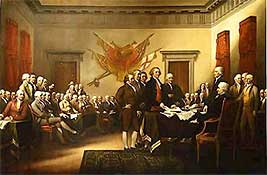 I spent this glorious afternoon in the park with a friend, who introduced me to her tradition of picking up the New York Times and reading the Declaration of Independence on every 4th of July . . . hope it was a great one for you, a time to pause and reflect on this nation and the principles upon which it was founded. Here's a roundup of some thoughts on the subject:
- Father Tucker (Dappled Things) on What's Right about America. (He also has some provocative thoughts about Pledging Allegiance to the Flag).
- Jay (De Ominis Gloria) offers a 4th of July Prayer.
- I. Shawn McElhinney shares the other verses to "America, The Beautiful", including the following:
O beautiful for pilgrim feet
Whose stern impassioned stress
A thoroughfare of freedom beat
Across the wilderness!
America! America!
God mend thine every flaw,
Confirm thy soul in self-control,
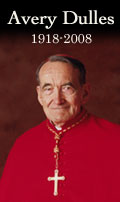
Thy liberty in law! A bit of history behind the tune and lyrics: The lyrics to this beautiful song were written by Katharine Lee Bates (1859-1929) an instructor at Wellesley College, Massachusetts, after an inspiring trip to the top of Pikes Peak, Colorado, in 1893. Her poem, America the Beautiful first appeared in print in The Congregationalist, a weekly journal, on July 4, 1895. Ms. Bates revised the lyrics in 1904 and again in 1913. In addition to those changes in the words, it is notable that the poem was not always sung to the tune presented on this website ("Materna," composed by Samuel A. Ward in 1882, nearly a decade before the poem was written). In fact, for two years after it was written it was sung to just about any popular or folk tune that would fit with the lyrics, with "Auld Lang Syne" being the most notable of those. . . . Before her death in 1929, Ms. Bates never indicated publicly which music she liked best, but it now appears likely that America the Beautiful will forever be associated with "Materna." "Confirm thy soul in self control, thy liberty in law" -- There's a lot that's packed into those lines, and every time I sing them -- that is to say, when I'm at an occasion where we actually bother to sing all the verses, which is rare -- I'm always reminded of the Catholic understanding of freedom, that is to say -- true freedom found in Christ and recognition of the moral law -- as opposed a libertinism which chains one to unrestrained appetite and the relectless pursuit of the ego, as aptly described in a favorite passage of mine from Thomas Howard's Christ the Tiger: And what is true here is true in all regions of experience. Your mad pursuit for freedom and intensity and bliss. It is natural. But, by a wry irony at work in the world, the pursuit leads you into a prison where your agony is to become more and more insistent that things shall be as you wish, and less and less able to cope with denial. But I show you a different way. It is an alien and frightening one. It is called Love. It asks that you forswear your busy effort to collect the bits of bliss and novelty that lie about. It asks that you disavow your attempt to enlarge your own identity by diminishing that of others. It asks that you cease your effort to safeguard your own claim to well-being by assuming the inferiority of others' claims. It asks, actually, that you die. For, paradoxically, it offers you your own best being beyond this apparent immolation of yourself. It says that the cupidity energizing all your efforts is the principle that governs wherever hell is found, and that the dwellers in that realm are a withered host of wraiths, doomed to an eternal hunt for solidity and fulfillment among the shards that lie underfoot. This is not your best being. You were meant to find your home in the City of God, which is among you. Here duty is ecstacy. For that is what is meant by caritas: It is the freedom which follows upon the capacity to experience as joy what you are given to do. (For further meditations along these lines see Enjoying and Making Use of a Responsible Freedom, by Cardinal Avery Dulles. Religion & Liberty Volume 11, Number 5, Sept/Oct 2001) and "The Moral Foundations of Freedom", by George Weigel (Acton Lecture on Religion & Liberty. October 23, 2000). - Phil Dillon, "Prairie Apologist" has a post on Liberty - America's Grand Experiment with specific attention to religious liberty, as found in excerpts from "America's founding fathers, a great British thinker, and Pope John Paul II."
- Greg Mockeridge (Cooperatores Veritatis) takes a look at The Declaration of Independence from a Catholic Perspective
In any event, independence is the object of our celebration. It's the foundation of our country. It is therefore important that we as Americans have a basic understanding of what independence means from a truly American perspective, particularly when you consider the fact that many people in our country, including but not limited to at least six out of our nine Supreme Court Justices, are confused as to what that is. Just as one cannot be a good Catholic without having a fundamental understanding of the faith one cannot be a good citizen without knowing his own national heritage. . . . Far from relieving us this patriotic duty of learning our American heritage, our Catholic faith actually reinforces it. Vatican II, in it's pastoral constitution on modern world Gaudium et Spes states that "Citizens must cultivate a generous and loyal spirit of patriotism . . . (#73)" It would naturally follow from this that the American Catholic would want to know what, if anything, do the ideas contained in the Declaration of Independence share in common with our Catholic faith. - On a similar note, see "The Religious Heritage of American Democracy" by Joseph S. Costanzo and The Faith at the Founding, by Michael Novak First Things 132 (April 2003): 27-32, on the religion of our founding fathers and proper place thereof in the "American experiment."
- Finally, just in case you missed the fireworks -- put on a virtual fireworks show above the Statue of Liberty in NYC.
|
From the new blog

|













![[Powered by Blogger]](http://buttons.blogger.com/bloggerbutton1.gif)