|
||
|
||
|
Saturday, September 01, 2007
Revolutionary Intellectuals
Some scattered thoughts occasioned by Gerald Augustinus' dismissal of Jean Paul Sartre at Closed Cafeteria (to which Michael Joseph @ Vox Nova predictably took offense) -- the former referencing Fr. Neuhaus' post Sartre, Legal Scholarship, and Those Troublesome Male Pronouns "On the Square") and the following excerpt from Clive James' Cultural Amnesia: Necessary Memories from History and the Arts:
“In Sartre’s style of argument, German metaphysics met French sophistry in a kind of European Coal and Steel Community producing nothing but rhetorical gas.” But wait, he is just warming up. “[Sartre] might have known that he was debarred by nature from telling the truth for long about anything that mattered, because telling the truth was something that ordinary men did, and his urge to be extraordinary was, for him, more of a motive force than merely to see the world as it was.” [...]If Gerald is dismissive of Sartre's "rhetorical gas", it seems he certainly isn't the only one. =) I can relate. I read a few of Sartre's plays and selections from Being and Nothingness (in Solomon's introductory anthology Existentialism). Sartre's concept of "bad faith" and the claim that "existence precedes essence" captivated me, then still in the throes of teenage rebellion (there's nothing more satisfying than reading a pompous French philosopher who'll provide intellectual justification to "doing your own thing" and giving the finger to authority). Reading John Derbyshire, I see I wasn't the only one indulging in such youthful fascination: Back in my student days, I read all the way through Sartre's novels, and a couple of the plays. In one of the novels a character steals a book, not because he has a genuinely criminal nature, or because he can't afford to buy it, but as a gesture of existential authenticity. Well, I was so impressed by this, I followed his example. I stole a book from a bookstore, to assert my precious existential authenticity, though also to see what it felt like.At any rate, you can only go so far with the possibilities of freedom and authenticity in a godless world devoid of truth and objective morality. Gerald maintains "My main problem lies with Sartre’s horrible defense - and even advocacy - of Communist and other atrocities," to which Michael responds: Sartre’s admiration for Che is not essential to Sartre’s existentialism, and as atrocious as Che’s deeds were, decrying this admiration does not refute Sartre. That’s like saying that Heidegger’s involvement with the Nazi’s means he got the question of being all wrong. As deplorable as Sartre’s and Heidegger’s politics were (let us not forget that Fr. Karl Adam, the author of The Spirit of Catholicism, was a Nazi sympathizer), we cannot simply dismiss their deep philosophies outright without giving them their due consideration. Freedom from sin and from character flaws certainly is not a prerequisite for stunning intellectual achievement.This is certainly true and I agree. But if we "cannot dismiss their philosophies outright without giving them due consideration," we should also give due consideration to the possible ways in which the philosophy expounded by an individual influenced his or her manner of life, inasmuch as the spheres of thought and life are intertwined (so to speak). For example, I thought Rudiger Safranski made a good case in Heidegger: Between Good and Evil as to how Heidegger's preoccupation with his own philosophy led him by the nose into Nazism, supposing an affinity between his thought and "the inner truth and greatness" of National Socialism, and to proclaim that "the Fuhrer himself and alone is the present and future German reality and its law."
We are faced with a Heidegger who is woven into his own dream of a history of being, and his movements on the political state are those of a philosophical dreamer. In a late letter he would concede to Jaspers that he had dreamed "politically" and therefore had been mistaken. But that he was politically mistaken because he had dreamed "philosophically" -- that he would never admit, because as a philosopher who wished to discover the essence of historical time he was bound to defend -- even to himself -- his philosophical interpretative competence for what was happening in political history. Sartre and Communism A reader in Closed Cafeteria's combox recommended Paul Johnson's Intellectuals, in which he devotes a chapter to Sartre, who comes across as a man with little if any redeeming moral qualities. On the matter of Sartre's "flirtation" with communism itself: Sartre's aligning himself with the Commmunists in 1952 made no logical sense at all. That was just the time when other left-wing intellectuals were leaving the Communist Party in droves, as Stalin's dreadful crimes were documented and acknowledged throughout the West. So Sartre now found himself standing on his head. He observed an uneasy silence about Stalin's camps, and his defence of his silence was a total contradiction of his manifesto on commitment in Les Temps modernes. 'As we were not members of the Party or avowed sympathizers,' he argued feebly, 'it was not our duty to write about Soviet labour camps; we were free to remain aloof from quarrels over the nature of this system, provided no events of sociological significance occured." He likewise forced himself to keep silent about the appalling trials in Prague of Slanksy and other Czech Jewish communists. Worse, he allowed himself to be made a performing bear at the absurd conference which the World Communist Peace Movement held in Vienna in December of 1952. This meant truckling to Fadayev, who had called him a hyena and a jackal, telling the delegates that the three most important events of his life were the Popular Front of 1936, the Liberation and 'this congress' -- a blatant lie -- and, not least, cancelling the performance in Vienna of his old, anti-communist play, Les Mains sales, at the behest of the Communist Party bosses.
"I lied. Actually, lie might be too strong a word: I wrote an article . . . where I said a number of things about the USSR I did not believe. I did it partly because I considered that it is not polite to denigrate your hosts as soon as you return home, and partly because I didn't really know where I stood in relation to both the USSR and my own ideas." [Situations X (Paris 1976, p. 220)That's not all, folks. According to Johnson, Sartre spent much of the 60's travelling in China and the Third World with de Beauvoir, hob-knobbing with Afro-Asian dictators and commending everybody from Castro's Cuba ("The country which has emerged out of the Cuban revolution is a direct democracy") to Tito's Yugoslavia ("It is the realization of my philosophy"). He condemned Americans for their war crimes in Vietnam and played a leading part in Bertrand Russell's "War Crimes Tribunal" in Stockholm.
This was an updating of existentialism: self-liberation through murder. It was Sartre who invented the verbal technique (culled from German philosophy) of identifying the existing order as "violent" (e.g., "institutionalized violence"), thus justifying killing to overthrow it. He asserted, "for me the essential problem is to reject the theory according to which the left ought not to answer violence with violence." [Interview in France-Observateur February 1, 1962] Note: not 'a' problem but 'the essential' problem. Since Sartre's writings were widely disseminated, especially among the young, he became the academic godfather to many terrorist movements . . . By helping Fanon to inflame Africa, he contributed to the civil wars and mass murders which have engulfed most of the continent from the mid-1960's onwards to this day. His influence in South-East Asia was even more baneful.Is it possible to separate Sartre’s politics from his philosophy so as to arrive at an appreciation of the latter? -- Perhaps, to a degree. I'd also wonder, what is the merit of studying it? Noting that 50,000 people attended his funeral, Johnson asks: What faith, what luminous truth about humanity, were they asserting by their mass presence? We may well ask. Focoult and the Iranian Revolution
Of all the absurd infatuations ever to sweep literary Paris, none has ever matched the absolute incongruity of Michel Foucault’s enthusiasm for the Iranian Islamic revolution of 1979. Foucault, a man utterly devoid of religious feeling, a homosexual who reveled in the brutalities of San Francisco’s sado-masochistic bar scene, decided in 1978 that the Khomeini revolution offered mankind’s best hope for personal liberation.See also The Philosopher and the Ayatollah, by Wesley Yang (Boston Globe June 12, 2005); Revisiting Foucault and the Iranian Revolution, by Janet Afary and Kevin B. Anderson (New Politics, vol. 10, no. 1 Summer 2004); for a book-length treatment of the matter in English: Foucault and the Iranian Revolution. From the Boston Globe: The Iranian Revolution, Anderson and Afary write, appealed to certain of Foucault's characteristic preoccupations — with the spontaneous eruption of resistance to established power, the exploration of the limits of rationality, and the creativity unleashed by people willing to risk death. It also tied into his burgeoning interest in a "political spirituality" (by which he meant the return of religion into politics, a suspicious phenomenon in rigorously secular France) whose rise was then still obscured by the Cold War. These preoccupations made Foucault both more sensitive to the power of political religion, but also more prone to soft-pedal its dangers. In his articles, Foucault compared the Islamists to Savonarola, the Anabaptists, and Cromwell's militant Puritans. The comparisons were intended to flatter. . . . Should one read Foucault? -- Again, perhaps "one can separate Foucault from his politics" and so come to an appreciation. Personally, I would be content to leave Foucault confined to the ivory tower of academica -- to inflict him on the 'man on the street' would be nothing less than torture -- and I'm no sadist.
Lastly, not everyone has the freedom of an grad-school academic. Primary sources are indeed beneficial if you have the time. However, circumstances may warrant making do with the lesser, especially if you're juggling a full time job. If you're not in a position to wade through 600+ pages of Being and Nothingness, getting by with introductions and "shoddy undergraduate courses" may just have to suffice. As far as existentialism goes, William Barret's Irrational Man remains a personal favorite and I'd readily recommmend it as a good overview of the subject. Update
Labels: extremism, foucault, heidegger, philosophy, sartre
|

Against The Grain is the personal blog of Christopher Blosser - web designer
and all around maintenance guy for the original Cardinal Ratzinger Fan Club (Now Pope Benedict XVI).
Blogroll
Religiously-Oriented
"Secular"
|
|
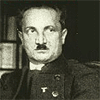 Safranski describes how the National Socialist Revolution had "electrified Heidegger philosophically". He perceived it as a metaphysical revolution, a "total overturning of our German Dasein"; breaking out from Plato's cave into authenticity and rebirth:
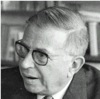 In an interview with Liberation, which Johnson describes as "the most groveling account of the Soviet state by a major Western intellectual since the notorious expedition by George Bernard Shaw in the early 1930's," Sartre claimed Soviet citizens did not travel -- not because they were constrained from doing so, but because they had no desire to leave their marvellous country. Moreover, he insisted, "there is total freedom of criticism in the USSR.' Years later, Sartre admitted of this interview:
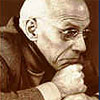 Just as Heidegger interpreted National Socialism through the "rose colored glasses" of his own philosophy and Sartre would display a fascination with Communism and Third World dictators in the revolutionary 60's, the French postmodernist Michael Foucault appears to have had a thing for the 1978 Iranian revolution. Or as













![[Powered by Blogger]](http://buttons.blogger.com/bloggerbutton1.gif)