Wednesday, November 21, 2007
The End of the Stem Cell Debate?
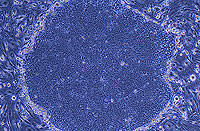 Human induced pluripotent stem cells, or iPS cells. Human induced pluripotent stem cells, or iPS cells.
Shinya Yamanaka / Department of Stem Cell Biology / AP |
According to the San Jose Mercury Newsa scientific breakthrough on the sem cell research front has the potential to end the stem cell debate, alleviating moral concerns over the exploitation of discarded embroyos: Advocates on both sides of the ethically charged debate over human embryonic stem cells hailed two breakthrough studies unveiled Tuesday that suggested simple human skin cells might one day lead to a vast array of new treatments without destroying embryos.
Until now, researchers hoping to use stem cells to create replacement organs and medicines for numerous diseases had assumed their best hope was with human embryonic stem cells, which have the flexibility to turn into any tissue type.
But the studies, published in the journals Cell and Science, indicate that other cells plucked from a person's hand or face may be just as useful. . . .
Although both teams cautioned that more studies are needed to perfect the procedure, other experts proclaimed the accomplishments as a promising way to avoid the ethical debate surrounding human embryonic stem cells, which come from 4- to 5-day-old discarded embryos.
"This is a tremendous scientific milestone - the biological equivalent of the Wright brothers' first airplane," said Dr. Robert Lanza, chief scientific officer for Advanced Cell Technology of Alameda. "It's a bit like learning how to turn lead into gold."
Time magazine reports how the process -- known as "direct reprogramming" is already changing the field: Ian Wilmut, the pioneering biologist responsible for cloning the first mammal, Dolly, has announced that he will no longer use the cloning method that made him famous to generate stem cells. "Changing cells from a patient directly into stem cells has got so much more potential," he says.
And generating stem cells is suddenly possible for anyone with a basic background in molecular biology. No special expertise in handling chromosomes, nuclei or eggs is needed.
Finally, the promise and potential of directly reprogrammed cells calls into question whether embryonic stem cells are useful any more. Why go to the trouble of creating embryos when stem cells can be coaxed directly from properly manipulated cells?
SEE ALSO:
- "A New Day", by Father Thomas Berg, LC, M.A., Ph.D.. The Weschester Institute for Ethics and the Human Person:
. . . It will take several days for us to ponder and assess the implications of all this, but even now, and based on what I am hearing from scientists and fellow ethicists who have followed the emergence of stem cell science in recent years, some implications are already clear, and they are marvelous.
First of all, the putative “need” for new lines of human embryonic stem cells will now fall under much tougher scientific scrutiny as enthusiasm for reprogramming re-dimensions the field. Dr. Wilmut himself was quoted as saying, “This approach represents the future for stem cell research.” Quite a statement from a stem cell pioneer.
Secondly, controversial therapeutic cloning now loses any plausible grounds for being a scientific and biomedical “must”. I don't believe today's news is going to stop researchers from attempting to clone human embryos to harvest embryonic stem cells from them. But their public support will be drastically reduced, and any private monies they had for this will likely dry up as well.
- “Direct Reprogramming & the End of Embryonic Stem Cell Research” - Commentary in the latest of a series on bioethics issues from Thomas Peters (The American Papist).
- Michael Liccione (Sacramentum Vitae) is cautiously optimistic.
|
From the new blog

|















![[Powered by Blogger]](http://buttons.blogger.com/bloggerbutton1.gif)