|
||
|
||
|
Thursday, March 20, 2008
Wherein lies the Kingdom?
The German Jesuit Alfred Delp, who was executed by the Nazis, once wrote: "Bread is important, freedom is more important, but most important of all is fidelity and faithful adoration."
Let us return to the third temptation. Its true content becomes apparent when throughout history we realize that it is constantly taking on new forms. The Christian empire attempted at an early stage to use faith in order to cement political unity. The Kingdom of Christ was not expected to take the form of a political kingdom and its splendour. The powerlessness of faith, the early powerlessness of Jesus Christ, was to be given the helping hand of political and military might. The temptation to use power to secure the faith has arisen again and again in varied forms throughout the centuries, and again and again faith has risked being suffocated in the embrace of power. The struggle for the freedom of the Church, the struggle to avoid identifying Jesus' Kingdom with any political structure, is one that has to be fought century after century. For the fusion of faith and political power comes at a price: faith becomes the servant of power and must bend to its criteria. [p. 40] 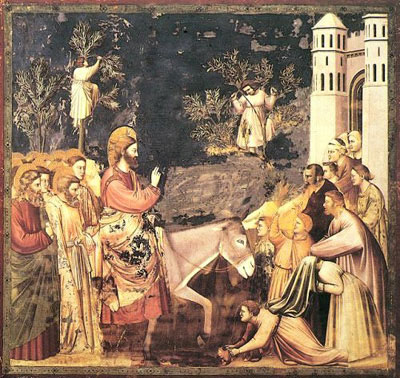
If we had to choose today, would Jesus of Nazareth, the son of Mary, the Son of the Father, have a chance? Do we really know Jesus at all? Do we understand him? Do we not have to perhaps make an effort, today as always, to get to know him all over again? The tempter is not so crude as to suggest to us directly that we should worship the devil. He merely suggests that we opt for a reasonable decision, that we choose to give priority to a planned and thoroughly organized world, where God may have his place as a private concern but must not interfere in our essential purposes. Soloviev attributes to the AntiChrist a book entitled The Open Way to World Peace and Welfare. This book becomes something of a new bible, whose real message is the worship of well-being and rational planning. [p. 41] The Passion narratives are the first pieces of the Gospels that were composed as a unity. In his preaching at Corinth, Paul initially wants to know nothing but the Cross, which "destroys the wisdom of the wise and wrecks the understanding of those who understand", which "is a scandal to the Jews and foolishness to the gentiles". But "the foolishness of God is wiser than men, and the weakness of God is stronger than men" (I Cor 1:19, 23, 25). Labels: food for thought
|

Against The Grain is the personal blog of Christopher Blosser - web designer
and all around maintenance guy for the original Cardinal Ratzinger Fan Club (Now Pope Benedict XVI).
Blogroll
Religiously-Oriented
"Secular"
|
|













![[Powered by Blogger]](http://buttons.blogger.com/bloggerbutton1.gif)