Tuesday, April 08, 2008
Kasper's critique of dual covenant theology: how Vatican II teaches prayer for Jewish conversion
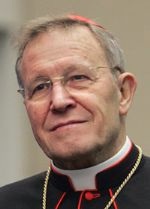 On Good Friday, Cardinal Walter Kasper, head of the Vatican's Commission for Religious Relations With the Jews, published an article defending Benedict XVI's revisions to the "Good Friday Prayer for the Jews" in the Frankfurter Allgemeine Zeitung: "Das Wann und Wie entscheidet Gott", March 21, 2008.
A reader of this blog, Dr Thomas Pink of King's College London, has kindly provided its translation into English, along with his extended observations in the form of a guest post below:
- Concerning the article's standing: I doubt this would have been published in the FAZ, a leading German paper of record, and the one highbrow broadsheet that has consistently given a platform to Benedict and to Benedict-supporters in the German Catholic Church - Die Zeit and the Sueddeutsche Zeitung are much more hostile - during the Triduum, and not long before the Secretary of State's Friday Statement, without some sort of vetting and acquiescence from the Pope.
That's of course surmise on my part, but it would be amazing if this were not the case. Moreover the references to the 1970 prayer and the significance of its retention for the continuing validity of Nostra Aetate are completely in line with the Friday Statement.
That does not mean of course that this is a formal doctrinal statement, or that the Pope would choose to express himself formally in the same terms. Benedict seems very tolerant of varieties of theological expression and viewpoint that he might not himself fully share, within the limits of what he sees as orthodoxy, especially in informal theological commentary.
Kasper's emphasis and choice of terms are certainly not those of Cardinal Schoenborn's recent Tablet defence of the Christian evangelization of Jews (Judaism’s way to salvation March 29, 2008). But I do not see any serious theological conflict between them or between either and Benedict.
- If there is an internal theological target being aimed at by Kasper, it is very clearly dual covenant theology. This is the view, increasingly widespread in certain US and German theological circles involved in Jewish dialogue, that the Jews have their own saving covenant distinct from and independent of that offered by Christ to the Gentiles, and that therefore there is no ground for Jews to convert to Christianity and enter the Church. Jewish conversion is not something for which the Church should call, pray, or strive. The dual covenant camp, theologians such as Pawlikowski et al, try and base all discussion on Nostra Aetate, and interpret this actually very short and vague declaration in isolation from preceding documents of the Council. They treat Nostra Aetate as a whole New Pentecost on its own, from which among Church documents all future Judaeo-Christian dialogue is supposed uniquely to develop, and on which whatever speculative theological structure they fancy can then be erected as new 'Church teaching'. Kasper will not have this, and reinforces the standing of Nostra Aetate by relating it to the rest of the Council, and in particular to the greater authority of Lumen Gentium. But the content of Lumen Gentium is flatly opposed to dual covenant theology, as we can see from Lumen Gentium paragraph 9, a passage that very clearly states Catholic teaching on the relation of the Jewish people to the Church and the New Covenant:
"[God] therefore chose the race of Israel as a people unto Himself. With it He set up a covenant. Step by step He taught and prepared this people, making known in its history both Himself and the decree of His will and making it holy unto Himself. All these things, however, were done by way of preparation and as a figure of that new and perfect covenant, which was to be ratified in Christ, and of that fuller revelation which was to be given through the Word of God Himself made flesh. "Behold the days shall come saith the Lord, and I will make a new covenant with the House of Israel, and with the house of Judah . . . I will give my law in their bowels, and I will write it in their heart, and I will be their God, and they shall be my people . . . For all of them shall know Me, from the least of them even to the greatest, saith the Lord." (Jeremiah 31) Christ instituted this new covenant, the new testament, that is to say, in His Blood, calling together a people made up of Jew and gentile, making them one, not according to the flesh but in the Spirit. This was to be the new People of God."
Dual covenant theology, it seems to me, cannot survive this passage.
Notice that here the Council quotes Jeremiah chapter 31 as a prophetic foretelling of the New Covenant. It is important that Kasper refers, via discussion of St Paul, to Jeremiah 31 too, as a prophetic foretelling of the future salvation of the Jews - which, by the Pauline argument, will consist in the future saving reincorporation of the Jews into the olive tree of salvation from which they have become cut off. That olive tree, then, in the context of Jeremiah 31 is Israel (as Lumen Gentium para 9 later on also terms the Church - the 'New Israel') considered as the People of Jeremiah's New Covenant. There is only one covenant for the Jews to return to, one shared with the Gentiles.
Another point that Kasper emphasizes repeatedly from the start is that Jesus really is the Christ, that is, the Jewish Messiah. But the logic of dual covenant theology is surely to put this in some doubt. (Or so I've always thought - and so Luke Timothy Johnson at least seems willing to move towards concluding: see this amazing piece in which Luke Timothy Johnson says, it seems, that Jews should not let Christians persuade them into seeing Jesus as truly the Jewish Messiah).
- The 2008 prayer clearly is viewed by Kasper (and one presumes Benedict as well) to concern the conversion of the Jewish people as a whole. This final conversion of the Jewish people as a people involves, surely, the disappearance of Judaism as a distinct religion that is rejecting of Jesus. And then the prayer so considered really is eschatological, not because the Jews don't need the knowledge of Christ as much as do Gentiles, or are saved through another covenant, but because of mysterious divine action which will be reversed only by a returning Christ. And here Kasper's scriptural argument looks pretty hard to challenge, is deeply Pauline, and is clearly nothing to do with dual covenant theology.
- Clearly St Paul in addressing the synagogues was aiming at conversions, and moved on only when he did not find them. This crucial use as an example of witness of St Paul distances Kasper's view of and endorsement of witness as a replacement for mission from any view that Catholics should never aim at or hope for or pray for Jewish conversions. It also links witness - with conversion as a possible goal - to interreligious dialogue as being mutually consistent, in just the way that liberals and some Jewish groups dislike. This fits with the fact that the Friday Statement pointedly refused to distance the Church from aiming at Jewish conversions in the here and now.
A mission to the Jews is being understood by Kasper, then, in rather a narrow sense - as Catholic institutional bodies or institutional events directed specifically at the conversion of the Jews as a whole people, that is, at a level involving the disappearance through conversion of a Jesus-rejecting Judaism as such. His detachment of the Church from Jewish mission in this sense does not apply, and is not applied by him to cover other forms of witness, such as Paul's visits to individual synagogues as part of a project of securing conversions generally, or Christian persuasion in the context of more general dialogic interaction.
- Hence in this field, traditionalist mistrust of Kasper seems misplaced, and is based on a misunderstanding. What he (and Benedict?) are doing is clearly detaching the Good Friday prayer from addressing the salvation of this or that Jewish individual, and centering it on the final salvation of the Jewish people as a people, that event that ends the existence of Judaism as a religion distinct from and in disagreement with Christianity. Kasper is saying that the Church is praying for just this event, but that it is not the business of the Church to attempt of itself to engineer conversion at this level, except indirectly through its mission to the Gentiles. But at the same time the eschatological reading of this prayer for the conversion of the Jewish people as a whole has no implication for projects of conversion at other levels.
Many orthodox Catholics have been suspicious of Kasper's use of an eschatological reading of the Good Friday prayer to distance the Church from any mission to the Jews in the present. They have viewed this as involving a location of the eschatological exclusively in some future never-never, and so as contrary to Benedict's teaching in this area and a weakening of it. For in the Pope's important March 15th 2006 address -- Benedict's Wednesday General Audience, March 15, 2006 -- Benedict very much talks the language of Lumen Gentium paragraph 9, and views the Church precisely as the New Israel into which, from the very beginning Jews as well as Gentiles are called to enter, emphasizing that the eschatological time is now, the time after Christ's incarnation. So Benedict is placing the eschatological time now, and is calling for conversion now. While since Kasper is denying a mission to the Jews, he is assumed by many Catholics to be eschewing, in opposition to the Pope, any call for Jewish conversion now, and must also, again in opposition to the Pope, be placing eschatological time in some indefinite future.
But the reality is different. It turns out that what matters in Kasper's use of the notion of eschatological time is not when it happens. Eschatology for Kasper picks out not an endlessly distant future - as Kasper says, God decides the when and the how, so it is not for us (or Kasper) to locate the eschatological presumptuously in some future never-never. Rather the eschatological for Kasper picks out a level at which, though the Church must call and pray for Jewish conversion and salvation, the direction of events is entirely in God's hands. The final disappearance of a Judaism rejecting of Jesus, whenever it happens - it could be now or it could be at any future date, but Kasper explicitly says we are to pray that it comes, Maranatha, soon, which hardly excludes now - is an event of this level. But witness to the Jews (with as with St Paul the possible goal of individual conversions) is not an event of this level, and it very much remains the responsibility of the Church and of individual Catholics. There is no difference with Benedict.
The 1962 and 1970 liturgies: united in prayer for Jewish conversion
It is very important that prayers for Jewish conversion occur in the 1970 liturgy, in the new Liturgy of the Hours. My thanks to Gregor Kollmorgen of the New Liturgical Movement for drawing attention to the following examples:
- E.g.: - Preces for Lauds of December 31st: “Christe, Deus et homo, qui Dominus es David et filius ejus, prophetias adimplens, te rogamus, ut Israel te Messiam agnoscat.” (Christ, God and man, who art the Lord of David and his son and fulfillest the prophecies, we beg thee, that Israel accept thee as the Messiah.)
- - Preces for II Vespers of Christmas: “Qui, a saeculis exspectatus, in plenitudine temporis venisti, manifesta praesentiam tuam iis, qui adhuc te exspectant.” (Thou, who hast been expected through the ages, and hast come in the fulness of time, manifest thy presence to those, who still look out for thee.)
- - Preces for Lauds on January 2nd: “Christe, quem ab angelis glorificatum et a pastoribus annuntiatum, Simeon et Anna confessi sunt et praedicaverunt, te rogamus, ut Evangelium tuum a populo promissionis recipiatur.” (Christ, whom the Angels glorified and the shepherds announced, and Simeon and Hannah professed and proclaimed, we beg thee, that thy Gospel be accepted by the people of thy promise.)
The lesson is clear: if Pawlikowski and his dual covenant school were right,, not only would Lumen Gentium, the central constitution of Vatican II, have to go, but the post-Vatican II liturgy of 1970 would as much need revision as that of 1962. (In fact you'd have to change not only the Liturgy of the Hours but probably the 1970 Missal too - such as the New Rite Easter Vigil prayers after the Old Testament readings or prophecies that, just as much as do the similar Old Rite prayers, treat the Church as the New Israel prefigured, with its sacraments, in the history of Israel of old.)
-- Dr Thomas Pink
Reader in Philosophy
Director, Centre for Philosophical Studies
Department of Philosophy
King's College London
|
From the new blog

|











![[Powered by Blogger]](http://buttons.blogger.com/bloggerbutton1.gif)