Tuesday, May 13, 2008
Irena Sendler 1910-2008: "Righteous Among the Nations"
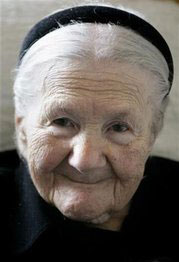
The face of a guardian angel - Irena Sendler 1910-2008 |
Irena Sendler, Lifeline to Young Jews, Is Dead at 98 New York Times May 13, 2008: Irena Sendler, a Roman Catholic who created a network of rescuers in Poland who smuggled about 2,500 Jewish children out of the Warsaw ghetto in World War II, some of them in coffins, died Monday in Warsaw. She was 98.
The death was confirmed by Stanlee Stahl, executive vice president of the Jewish Foundation for the Righteous, an organization that supports rescuers of Holocaust victims.
Mrs. Sendler was head of the children’s bureau of Zegota, an underground organization set up to save Jews after the Nazis invaded Poland on Sept. 1, 1939. Soon after the invasion, approximately 450,000 Jews, about 30 percent of Warsaw’s population, were crammed into a tiny section of the city and barricaded behind seven-foot-high walls.
On April 19, 1943, the Nazis began what they expected would be a rapid liquidation of the ghetto. It took them more than a month to quell the Warsaw ghetto uprising. By then, only about 55,000 Jews were still alive; most of them were sent to death camps.
Also by then, however, Mrs. Sendler’s group of about 30 volunteers, mostly women, had managed to slip hundreds of infants, young children and teenagers to safety.
“She was the inspiration and the prime mover for the whole network that saved those 2,500 Jewish children,” Debórah Dwork, the Rose professor of Holocaust history at Clark University in Massachusetts, said Monday. Professor Dwork, the author of “Children With a Star” (Yale University Press, 1991), said about 400 children had been directly smuggled out by Mrs. Sendler. ...
The Wikipedia entry has further details: In December 1942, the newly created, the newly created Children's Section of the Żegota (Council for Aid to Jews), nominated her (under her cover name Jolanta) to head its children's department. As an employee of the Social Welfare Department, she had a special permit to enter the Warsaw Ghetto, to check for signs of typhus, something the Nazis feared would spread beyond the ghetto. During the visits, she wore a Star of David as a sign of solidarity with the Jewish people and so as not to call attention to herself.
[Sendler] cooperated with the Children's Section of the Municipal Administration, linked with the RGO (Central Welfare Council), a Polish Relief Organization tolerated under German supervision. She organized the smuggling of Jewish children from the Ghetto, carrying them out in boxes, suitcases and trolleys. The children were placed with Polish families, the Warsaw orphanage of the Sisters of the Family of Mary or Roman Catholic convents such as the Sisters Little Servants of the Immaculate Conception of the Blessed Mary at Turkowice and Chotomów. Some were smuggled to priests in parish rectories where they could be further hidden. She kept lists of the names, hidden in jars, in order to keep track of their original and new identities.
Arrested in 1943 by the Gestapo, she was severely tortured and sentenced to death. The Żegota saved her by bribing the German guards on the way to her execution. She was left in the woods, unconscious and with broken arms and legs. Officially, she was listed on public bulletin boards as among those executed. Even in hiding, she continued her work for the Jewish children.
Related
 Life in a Jar: The Irena Sendler Project - a website by rural Kansas school students who -- initially skeptical about the claim to have saved 2,500 children -- started a research project: Life in a Jar: The Irena Sendler Project - a website by rural Kansas school students who -- initially skeptical about the claim to have saved 2,500 children -- started a research project:They found that Irena Sendler, as a non-Jewish social worker, had gone into the Warsaw Ghetto, talked Jewish parents and grandparents out of their children, rightly saying that all were going to die in the Ghetto or in death camps, taking the children past the Nazi guards (in body bags, saying they were ill, or using one of the many means of escape from the Ghetto-the old courthouse for example), and then adopting them into the homes of Polish families or hiding them in convents and orphanages. She made lists of the children's real names and put the lists in jars, then buried the jars in a garden, so that someday she could dig up the jars and find the children to tell them of their real identify.
The Nazi's captured her and she was beaten severely, but the Polish underground bribed a guard to release her, and she entered into hiding. The students wrote a performance (Life in a Jar) in which they portrayed the life of Irena Sendler. They have performed this program for numerous clubs and civic groups in the community, around the state of Kansas, all over the U.S. and in Europe (225 presentations as of November 2007). The community of Uniontown has little diversity and no Jewish students in the school district. The community was inspired by the project and sponsored an Irena Sendler Day. The students began to search for the final resting place of Irena and discovered she was still alive and living in Warsaw, Poland. Irena's story was unknown world-wide, even though she has received esteemed recognition from Yad Vashem in the 1960's and support from the Jewish Foundation for the Righteous in New York City. Forty-five years of communism had buried her story, even in her own country.
From that time on they would take a jar to every performance and collect fund for Irena and other Polish rescuers. ...
- A TV movie about the life of Holocaust hero Irena Sendler is being readied for production and will air next season on CBS:
"The Irena Sendler Story" is based on an authorized biography of the woman credited with rescuing some 2,500 Jewish children from the Nazis by smuggling them out of the Warsaw Ghetto, producer Hallmark Hall of Fame said Monday. ...John Kent Harrison, who became familiar with Sendler's bravery while in Poland three years ago filming a CBS miniseries about Pope John Paul II, wrote the script for the Sendler film and will direct.
The movie is drawn from the 2005 book "Mother of the Children of the Holocaust: The Irena Sendler Story," written by Anna Mieszkowska.
- I'm no hero, says woman who saved 2,500 ghetto children The Guardian March 15, 2007:
Mrs Sendlerowa, who is in a Warsaw nursing home, insisted she did nothing special.
In an interview she said: "I was brought up to believe that a person must be rescued when drowning, regardless of religion and nationality."
"The term 'hero' irritates me greatly. The opposite is true. I continue to have pangs of conscience that I did so little."
- Irena Sendler Tribute by Yad Vashem ("The Righeous Among the Nations").
|
From the new blog

|















![[Powered by Blogger]](http://buttons.blogger.com/bloggerbutton1.gif)