Friday, July 04, 2008
Pope John Paul II and Benedict XVI on the American Founding
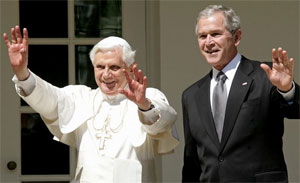 From the dawn of the Republic, America’s quest for freedom has been guided by the conviction that the principles governing political and social life are intimately linked to a moral order based on the dominion of God the Creator. The framers of this nation’s founding documents drew upon this conviction when they proclaimed the “self-evident truth” that all men are created equal and endowed with inalienable rights grounded in the laws of nature and of nature’s God. The course of American history demonstrates the difficulties, the struggles, and the great intellectual and moral resolve which were demanded to shape a society which faithfully embodied these noble principles. In that process, which forged the soul of the nation, religious beliefs were a constant inspiration and driving force, as for example in the struggle against slavery and in the civil rights movement. In our time too, particularly in moments of crisis, Americans continue to find their strength in a commitment to this patrimony of shared ideals and aspirations. ...
Historically, not only Catholics, but all believers have found here the freedom to worship God in accordance with the dictates of their conscience, while at the same time being accepted as part of a commonwealth in which each individual and group can make its voice heard. As the nation faces the increasingly complex political and ethical issues of our time, I am confident that the American people will find in their religious beliefs a precious source of insight and an inspiration to pursue reasoned, responsible and respectful dialogue in the effort to build a more humane and free society.
Freedom is not only a gift, but also a summons to personal responsibility. Americans know this from experience – almost every town in this country has its monuments honoring those who sacrificed their lives in defense of freedom, both at home and abroad. The preservation of freedom calls for the cultivation of virtue, self-discipline, sacrifice for the common good and a sense of responsibility towards the less fortunate. It also demands the courage to engage in civic life and to bring one’s deepest beliefs and values to reasoned public debate. In a word, freedom is ever new. It is a challenge held out to each generation, and it must constantly be won over for the cause of good (cf. Spe Salvi, 24). Few have understood this as clearly as the late Pope John Paul II. In reflecting on the spiritual victory of freedom over totalitarianism in his native Poland and in eastern Europe, he reminded us that history shows, time and again, that “in a world without truth, freedom loses its foundation”, and a democracy without values can lose its very soul (cf. Centesimus Annus, 46). Those prophetic words in some sense echo the conviction of President Washington, expressed in his Farewell Address, that religion and morality represent “indispensable supports” of political prosperity. Excerpts from the White House Welcoming Ceremony Pope Benedict XVI (Apostolic visit to the United States April 16, 2008).
* * *You represent a nation that plays a crucial role in world events today. The United States carries a weighty and far-reaching responsibility, not only for the well-being of its own people, but for the development and destiny of peoples throughout the world. With a deep sense of participation in the joys and hopes, the sorrows, anxieties, and aspirations of the entire human family, the Holy See is a willing partner in every effort to build a world of genuine peace and justice for all. ...
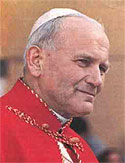 The Founding Fathers of the United States asserted their claim to freedom and independence on the basis of certain "self-evident" truths about the human person: truths which could be discerned in human nature, built into it by "nature’s God." Thus they meant to bring into being, not just an independent territory, but a great experiment in what George Washington called "ordered liberty": an experiment in which men and women would enjoy equality of rights and opportunities in the pursuit of happiness and in service to the common good. Reading the founding documents of the United States, one has to be impressed by the concept of freedom they enshrine: a freedom designed to enable people to fulfill their duties and responsibilities toward the family and toward the common good of the community. Their authors clearly understood that there could be no true freedom without moral responsibility and accountability, and no happiness without respect and support for the natural units or groupings through which people exist, develop, and seek the higher purposes of life in concert with others. The Founding Fathers of the United States asserted their claim to freedom and independence on the basis of certain "self-evident" truths about the human person: truths which could be discerned in human nature, built into it by "nature’s God." Thus they meant to bring into being, not just an independent territory, but a great experiment in what George Washington called "ordered liberty": an experiment in which men and women would enjoy equality of rights and opportunities in the pursuit of happiness and in service to the common good. Reading the founding documents of the United States, one has to be impressed by the concept of freedom they enshrine: a freedom designed to enable people to fulfill their duties and responsibilities toward the family and toward the common good of the community. Their authors clearly understood that there could be no true freedom without moral responsibility and accountability, and no happiness without respect and support for the natural units or groupings through which people exist, develop, and seek the higher purposes of life in concert with others.
The American democratic experiment has been successful in many ways. Millions of people around the world look to the United States as a model in their search for freedom, dignity, and prosperity. But the continuing success of American democracy depends on the degree to which each new generation, native-born and immigrant, makes its own the moral truths on which the Founding Fathers staked the future of your Republic. Their commitment to build a free society with liberty and justice for all must be constantly renewed if the United States is to fulfill the destiny to which the Founders pledged their "lives . . . fortunes . . . and sacred honor."
Respect for religious conviction played no small part in the birth and early development of the United States. Thus John Dickinson, Chairman of the Committee for the Declaration of Independence, said in 1776: "Our liberties do not come from charters; for these are only the declaration of preexisting rights. They do not depend on parchments or seals; but come from the King of Kings and the Lord of all the earth." Indeed it may be asked whether the American democratic experiment would have been possible, or how well it will succeed in the future, without a deeply rooted vision of divine providence over the individual and over the fate of nations. John Paul II on the American Experiment - excerpts from Pope John Paul II's words to the Honorable Lindy Boggs as Ambassador to the Holy See on December 16, 1997.
|
From the new blog

|














![[Powered by Blogger]](http://buttons.blogger.com/bloggerbutton1.gif)