Occasional notes by the guy who maintains the RatzingerFanClub and the Pope Benedict XVI Fan Club.

"perhaps the most underrated
weblog at St. Blog's"
- I. Shawn McElhinney

Contact me at: blostopher "at" gmail.com
Like my blogging? - Buy me a book!

RSS Feed Current Blog

<< # St. Blog's Parish ? >>

Pope Benedict XVI Fan Club
Pope John Paul II
Benedict In America
Catholics in the Public Square
Cardinal Francis Arinze
Hans Urs von Balthasar
Cardinal Avery Dulles

Catholic Just War Tradition
Catholic Friends of Israel
Catholic Church and Liberal Tradition
Pope Pius XII
The Da Vinci Code
Fr. John Courtney Murray
Richard J. Neuhaus
George Weigel
Michael Novak
George Weigel
Tolkien
Walker Percy
Prayer for Those in Service
in Time of War

Almighty God, our heavenly Father, let thy protection be upon all those who are in the service of our country; guard them from all harm and danger of body and soul; sustain and comfort those as home, especially in their hours of loneliness, anxiety, and sorrow; prepare the dying for death and the living for your service; give success to our arms on land and sea and in the air; and grant unto us and all nations a speedy, just and lasting peace. Amen.

Please Note: Recognition of the following blogs & periodicals should not be considered personal endorsement of the opinions contained therein, especially when content is not consistent with Church teaching.

RECENT POSTS


Michael Gerson on the New Eugenics and 'Trig's Bre...
Catholics Against Joe Biden
Archbishop Charles J. Chaput's "Render Unto Caesar...
Feast of the Assumption
Here & There ...
Congratulations, USA!!!
Fernando Lugo and Leonardo Boff: Liberation Theolo...
Benedict in Bressanone
40th Anniversary of Humanae Vitae

Ignatius Press - Catholic Books

BLOGS I READ

Religiously-Oriented

Blogroll Me!

"Secular"

<< # Catholic Bloggers ? >>

Periodicals:

Religious

Canticle Magazine
Chiesa
Christianity Today
Communio
Commonweal
Cross Currents
Crisis Magazine
First Things
InsideCatholic.com
Inside the Vatican
Lay Witness
Mennonite Quarterly Review
National Catholic Register
New Atlantis
New Oxford Review
The New Pantagruel
Perspectives
Second Spring
Saint Austin Review
The Tablet [U.K.]
Thirty Days
Touchstone
Traces

Secular

The American Conservative
American Outlook
The American Spectator
The Atlantic
Claremont Review of Books
City Journal
Commentary
The Economist
Foreign Affairs
Hoover Digest
Middle East Quarterly
National Review
The New Atlantis
The New Criterion
The New Republic
Newsweek
New York Review of Books
Orbis
OpinionJournal.Com
Policy Review
The Public Interest
Weekly Standard
Wilson Quarterly

Newspapers - (Daily)

Al-Ahram
The Guardian
Ha'aretz
The Independant
The Jerusalem Post
The New York Times
New York Post
Times Online (U.K.)
Washington Post
The Washington Times

Newspapers - (Weekly or Monthly)

The Forward
Houston Catholic Worker Newspaper
The Jewish Week
New York Press
The NonViolent Activist
Role Call
Zinda Magazine

Online Commentary
BeliefNet
Catholic Exchange
FrontPagMag.com
CruxNews
GodSpy
Spirit Daily
WorldNetDaily
Word from Rome
by John Allen Jr.

News

BBC News
CNN.Com
DrudgeReport
FoxNews
Google News
Haaretz Daily
New York Times
Times Online (U.K.)
Washington Times
Yahoo News

For an Occasional Laugh:

The Onion

Hungry? Order Online from Delivery.com

[Powered by Blogger]

Locations of visitors to this page
Blogarama
Subscribe with Bloglines

This Site Adheres to the Welborn Protocol: All correspondence is blogable unless you specifically request otherwise.

DISCLAIMER: The opinions expressed on this blog do not necessarily reflect those held by Pope Benedict XVI or other members of the 'Ratzinger Fan Club' website, which serves as host to this online journal.

COMMENTS POLICY (inspired by Donald Sensing):

  • No profanity!
  • No personal attacks.
  • No commercial commenting (links to your own blog site or relevant URL's permitted).
  • Keep in mind I have a day job -- hence, no time to respond to any and all comments. When I do so, it's as time permits.
  • Lastly, think before you post, and be considerate of others. Your comments may be recorded for posterity -- or the duration of Haloscan's memory.
  • Monday, September 15, 2008

    Benedict, Sarkozy and "Positive Secularism"

    A prevalent topic in Benedict's apostolic journey to France is (understandably) the role played by religion within the context of France's longstanding enforcement of secularity, or laïcité.

    During a brief press conference on Friday, when asked whether "France is losing its Christian identity because of laicism" -- Pope Benedict responded in the negative:

    It seems evident to me today that laicism does not contradict the faith. I would even say that it is a fruit of the faith, since the Christian faith was a universal religion from the beginning. Therefore it did not identify itself with a state and it was present in all the states. It was always clear to the Christians that religion and faith were not political, but rather they formed part of another sphere of human life. ... Politics, the state, were not a religion but rather a secular reality with a specific mission, and the two of them should be open to each other.

    In this sense, I would say today that for the French, and not only the French, but also for us, Christians of today in this secularized world, it is important to joyfully live the freedom of our faith, live the beauty of the faith, and show today's world that it is beautiful to be a believer, that it is beautiful to know God; God with a human face in Jesus Christ, show that it is possible to be a believer today, and even that society needs there to be people who know God and who, therefore, can live according to the great values that it has given us and contribute to the presence of these values that are fundamental for the building and survival of our states and societies.

    Later, during a meeting with French politicians at the Elysée Palace, after reminding his audience of France's Christian heritage and roots, the Holy Father again urged a rethinking of the relationship between church and state:

    Many people, here in France as elsewhere, have reflected on the relations between Church and State. Indeed, Christ had already offered the basic principle for a just solution to the problem of relations between the political sphere and the religious sphere when, in answer to a question, he said: “Render to Caesar the things that are Caesar’s, and to God the things that are God’s” (Mk 12:17). The Church in France currently benefits from a “regime of freedom”. Past suspicion has been gradually transformed into a serene and positive dialogue that continues to grow stronger. A new instrument of dialogue has been in place since 2002, and I have much confidence in its work, given the mutual good will. We know that there are still some areas open to dialogue which we will have to pursue and redevelop step by step with determination and patience. You yourself, Mr President, have used the fine expression “laïcité positive” to characterize this more open understanding. At this moment in history when cultures continue to cross paths more frequently, I am firmly convinced that a new reflection on the true meaning and importance of laïcité is now necessary. In fact, it is fundamental, on the one hand, to insist on the distinction between the political realm and that of religion in order to preserve both the religious freedom of citizens and the responsibility of the State towards them; and, on the other hand, to become more aware of the irreplaceable role of religion for the formation of consciences and the contribution which it can bring to – among other things – the creation of a basic ethical consensus in society.
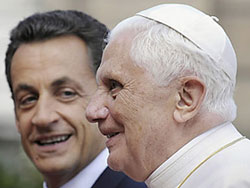
    Benedict's discussion of the issue has found a sympathetic listener in the person of French President Nicolas Sarkozy. The Christian Science Monitor reports:
    Unlike any French president in decades, Mr. Sarkozy sees a more open role for religion in French society. And he seized upon the conservative German pope's four-day trip to directly challenge French secularism, one of the most prized traditions of La République and a strict legal and cultural sanction against bringing matters of church and faith into the public realm.

    Secularism, or laïcité, is central to the modern French identity. It's a result of hundreds of years of efforts to remove the influence of the Roman Catholic church from French institutions and reduce its moral authority. French media don't discuss religion. At offices or work, most French believers don't tell colleagues they are going to mass or church. It is seen as a private matter.

    Yet here on Friday Sarkozy and his wife, Carla Bruni, broke protocol and met the pope at the airport. They hosted the pontiff at the Élysée Palace, attended a papal talk at a newly restored Cistercian monastery in downtown Paris in front of 700 intellectuals and artists – where Sarkozy openly argued that while secularism is important, it should not be a hostile force that forbids all talk of God, faith, and transcendence. Sarkozy called for a "positive laïcité" that allows religion to help forge an ethical society.

    "It would be crazy to deprive ourselves of religion," remarked Sarkozy, condemning such repression as "a failing against culture and against thought" (Zenit News Service):
    Religion, began Sarkozy, "and in particular the Christian religion, with which we share a long history, are living patrimonies of reflection and thought, not only about God, but also about man, society, and that which is a central concern for us today, nature."

    It would be crazy to deprive ourselves of religion; [it would be] a failing against culture and against thought. For this reason, I am calling for a positive secularity," he said. "A positive secularity offers our consciences the possibility to interchange -- above and beyond our beliefs and rites -- the sense we want to give to our lives."

    The president explained the areas in which this vision of secularism could take root: "France has begun, together with Europe, a reflection on the morality of capitalism.

    "Economic growth doesn't make sense if it becomes it's own objective. Only the betterment of the situation of the greatest number of persons and their personal fulfillment constitute legitimate objectives.

    "This teaching, that forms part of the heart of the social doctrine of the Church, is in perfect consonance with the challenges of the globalized contemporary economy. Our duty is to listen to it."

    "Positive secularism, open secularism, is an invitation to dialogue, to tolerance and respect," Sarkozy acknowledged. "It is an opportunity, an encouragement, a supplementary dimension to the political debate. It is an encouragement to religion, as well as to all currents of thought."

    According to the papers, Sarkozy is twice-divorced and a "lapsed Catholic", in light of which I find it most encouraging to see him taking a stand in this manner against stiff opposition from militant secularists.

    Related

    |