|
||
|
||
|
Sunday, January 09, 2005
Thomas Merton Revisited
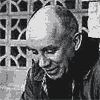 I came across (and posted) this excerpt from Merton's journals last year, but in light of the reception of my recent post, I think some of my (newer) readers would find it interesting: I came across (and posted) this excerpt from Merton's journals last year, but in light of the reception of my recent post, I think some of my (newer) readers would find it interesting:In the climate of the Second Vatican Council, of ecumenism, of openness, the word "heretic" has become not only unpopular but unspeakable -- except, of course, among integralists, who often deconstruct their own identity on accusations of heresy directed at others.
But has the concept of heresy become completely irrelevant? Has our awareness of the duty of tolerance and charity toward the sincere conscience of others absolved us from the danger of the error ourselves? Or is error something we no longer consider dangerous? I think a Catholic is bound to remember that his faith is directed to the grasp of truths revealed by God, which are not mere opinions or "manners of speaking," mere viewpoints which can be adopted and rejected at will -- for otherwise the commitment of faith would lack not only totality but even seriousness. The Catholic is one who stakes his life on certain truths revealed by God. If these truths cease to apply, his life ceases to have meaning. A heretic is first of all a believer. Today the ideas of "heretic" and "unbeliever" are generally confused. In point of fact the mass of "post-Christian" men in Western society can no longer be considered heretics and heresy is, for them, no problem. It is, however, a problem for the believer who is too eager to identify himself with their unbelief in order to "win them for Christ." Where the real danger of heresy exists for the Catholic today is precisely in that "believing" zeal which, eager to open up new aspects and new dimensions of the faith, thoughtlessly or carelessly sacrifices something essential to Christian truth, on the grounds that this is no longer comprehensible to modern man. Heresy is precisely a "choice" which, for human motives . . . selects and prefers an opinion contrary to revealed truth as held and understood by the Church. I think, then, that in our eagerness to go out to modern man and meet him on his own ground, accepting him as he is, we must also be truly what we are. If we come to him as Christians we can certainly understand and have compassion for his unbelief -- his apparent incapacity to believe. But it would seem a bit absurd for us, precisely as Christians, to pat him on the arm and say "As a matter of fact I don't find the Incarnation credible myself. Let's just consider that Christ was a nice man who devoted himself to helping others!" This would, of course, be heresy in a Catholic whose faith is a radical and total commitment to the truth of the Incarnation and Redemption as revealed by God and taught by the Church. . . . What is the use of coming to modern man with the claim that you have a Christian mission -- that you are sent in the name of Christ -- if in the same breath you deny Him by whom you claim to be sent? Thomas Merton Conjectures is a compilation of Merton's notes and spiritual reflections during the 1960's, and was first published in 1968, the same year Merton had, according to Msgr. Michael J. Wrenn and Kenneth D. Whitehead, "drifted away from the faith" and had fled to Asia to become a Buddhist. As Teófilo (Theophilus) (Vivificat) noted in his comments on my original post, "Theologically, though, one needs to read Merton's journals to get the feel on how conservative he really was. Again, the key is found in his journals." On the subject of "Vindicating Thomas Merton," Teófilo posts another remarkable excerpt from Merton's journals (June 6, 1965), in which he specifically comments on his "interest in the East." What Merton says in response is in itself an affirmation of the 'Christo-centric' nature of his reflections, even in the very last months of his life. Labels: merton
|

Against The Grain is the personal blog of Christopher Blosser - web designer
and all around maintenance guy for the original Cardinal Ratzinger Fan Club (Now Pope Benedict XVI).
Blogroll
Religiously-Oriented
"Secular"
|
|













![[Powered by Blogger]](http://buttons.blogger.com/bloggerbutton1.gif)