Monday, June 06, 2005
Pope Benedict XVI Roundup!
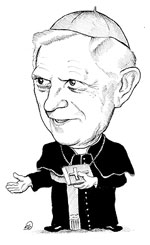 - The Promise of Benedict XVI, by Timothy George. The Dean of Beeson Divinity School of Samford University, thinks that:
"John Paul II will long be remembered as the greatest pope since the Reformation. His successor, Benedict XVI, may well turn out to be the harbinger of a new reformation. . . . I am not predicting that Benedict XVI will follow suit and preside over a new council, Vatican III. But I do believe his pontificate will be one of great moment for the Christian church, not least for evangelicals. George offers five reasons why "evangelical Protestants, and orthodox believers of all persuasions, should be pleased at the election of Pope Benedict XVI." Take a look. - "I Don't Think Benedict XVI's 'Program' Is to Combat Relativism" Zenit interviews Journalist Andrea Tornielli of Il Giornale. May 22, 2005:
Just as I avoid the caricature that certain progressive environments have made of Ratzinger over the past 20 years, I also try to be on guard against a certain error: to think that he will be a Pope on the basis of what Cardinal Ratzinger, prefect of the Congregation for the Doctrine of the Faith, was and said. I don't think that Benedict XVI's "program" is to combat relativism. I believe, instead, that he will seek to proclaim and witness the simplicity, purity and beauty of faith in Jesus Christ. The antidote to relativism is not a program, it is not a theory, it is not and can never be an invective or a denunciation. An invective, a denunciation, however, were more useful vis-à-vis communism. No, the antidote is in a people, even small in number, that lives the faith and witnesses the fullness of life. - In his latest Word from Rome, John Allen Jr. assesses the first 45 days of Pope Benedict XVI's pontificate:
The pope has been more critical in describing negative trends in the broader culture. Yet so far, the overwhelming tone of his teaching has been positive, rather than the condemnation of error. Benedict XVI may prove to be less censorious than many had expected. Second, it's interesting to note that despite Cardinal Joseph Ratzinger's frequent criticism of what he described as hasty or excessive reforms following the Second Vatican Council (1962-65), Vatican II is by far the most-cited source in Pope Benedict's teaching other than his immediate predecessor, John Paul II. So far, the pope has explicitly cited Vatican II fifteen times. That seems a signal that Benedict, who was a peritus, or theological expert, at Vatican II, intends to align himself with the council, at least as he understands and interprets it. After presenting five "big ideas" that have distinguished themselves in the Holy Father's words to date, Allen turns to Benedict "as governor," as "collegial pope," and thoughts on his style of leadership. An interesting development from one who had formerly portrayed the Pope as "The Vatican's Enforcer." - Pope Catholic - Media Shocked! - Jeff Miller aka. The Curt Jester critiques the media response to an address by Pope Benedict XVI, in which he reiterated basic Catholic teaching on a number of moral issues. The MSM (Mainstream Media) took it as a revelation that the Pope is not as cute and cuddly as they had hoped for.
Further commentary on condemnation of "pseudo-marriages" by Dave Morrison (Sed Contra). - Last Saturday the Holy Father celebrated the 28th anniversary of his episcopal ordination:
Father Joseph Ratzinger, a member of the International Theological Commission, was appointed archbishop of Munich and Freising by Pope Paul VI on March 24, 1977, and received episcopal ordination from the hands of Bishop Josef Stangl of Wuerzburg the following May 28. Father Ratzinger, who had just celebrated his 50th birthday, became the first diocesan priest in 80 years to assume the pastoral governance of the large Bavarian archdiocese. Paul VI elevated him to cardinal just a month later, on June 27. In his autobiography "Milestones: Memoirs 1927-1977" (Ignatius Press, 1999), Cardinal Ratzinger recalled the date of his episcopal consecration as "an extraordinarily beautiful day," "a radiant day at the beginning of summer, on the vigil of Pentecost of 1977." - "The Sacrament of Unity" translation of the homily Benedict XVI gave today in Italian during the closing Mass of the 24th Italian National Eucharistic Congress, in the esplanade of Marisabella. Zenit. May 29, 2005. According to Zenit News Service, "the Eucharistic congress, which has gathered representatives of all the ecclesial entities of Italy, opened with the theme "We Cannot Live Without Sunday." The theme is taken from the words expressed by the 49 martyrs of Abitene, a city of the Roman province of Proconsular Africa, today's Tunis, in the year 303, during the persecution of the emperor Diocletian."
- Oswald Sobrino @ Catholic Analysis on "Ratzinger on Eucharist and Parousia":
"Parousia" is the Greek New Testament term meaning "presence" that is used to refer to the Second Coming of Christ. In a popular EWTN video series by Scott Hahn and Mike Aquilina, Hahn speaks of the Eucharist as an experience of the parousia, both in the sense that Christ comes in the Eucharist and in the sense of looking forward to Christ coming again at the end of the age. Hahn notes in the video series that the ancient Christian Aramaic prayer "maranatha" is both a plea of "Come, Lord Jesus" and a proclamation that the Lord Jesus has already come. Well, back in 1977, theologian Joseph Ratzinger, as he embarked on his career as a bishop, made the very same observation . . . [UPDATE: Ratzinger, Parousia and the Eucharist - a continuation of the previous post]. - Writing on the pernicious effect of relativism on Christian missions, one encounters this little display of what I believe is the Holy Father's sense of humor:
The dogma of relativism has, however, yet another effect: Christian universalism, which is carried out concretely in mission, is no longer the obligatory handling on of a good meant for everyone, that is, of truth and love; with this presupposition, mission becomes the mere presumptuous attitude of a culture that imagines itself to be superior, that tramples upon a whole multitude of religious cultures in the most shameful fashion, thus, it is held, depriving these people of what is best: their own heritage. Thence comes the imperative: Give us back our religions, as the right ways for the various peoples to come to God and God to them; where these religions still exist, do not touch them! Is this demand appropriate? It is at any rate there that the good sense, or nonsense, of the dogma of relativism in the sphere of cultures and religions must be demonstrated. At least, in the face of such demands, one ought to look carefully at each religion to see whether its restoration would really be desirable. When we think, for instance, of how on the occasion of the most recent rebuilding of the main Aztec temple, in the year 1487, "at the very lowest estimate, twenty thousand people" bled to death, "over four days, on the alters of Tenochtitlan" (the capital city of the Aztecs, in the upper Mexico valley) as human sacrifices to the sun god, it would be difficult for us to encourage this restoration of religion. . . . To the earth gods and the vegetation gods, the Aztecs offered "men and women, who were for the most part flayed alive"; to the gods of rain, who were thought of as being like dwarfs, they offered up little children, who were drowned in springs, in water holes, and in certain parts of the Lake of Tetzcoco. There were rituals, a part of which was the slaughter of human beings. All of this derived, as W. Krickeberg has established, not from some inborn "inclination to bloodthirstiness", but from a fanatical belief in the duty of men to provide in this fashion for the continuation of the world. This, of course, is an extreme instance, but it nonetheless shows that one cannot simply see in any and every religion the way for God to come to man and man to God. From Truth & Tolerance: Christian Belief and World Religions pp. 73-75 (Ignatius, 2004). According to Ratzinger, differing variants of the lecture from which this was excerpted was read at the Salzberg Higher Education week in 1992, at a meeting of the CDF with the Asian Bishops Conference in 1993, and at an educational function in Sassari (Sardinia). I must say I'm curious whether the above passage made it into the lecture? =)
Labels: benedict, benedict roundup
|
From the new blog

|







![[Powered by Blogger]](http://buttons.blogger.com/bloggerbutton1.gif)