|
|||||
|
|||||
|
Saturday, January 29, 2005
Iraqi Elections - Ongoing Roundup of Blogs & Commentary


So that's the roundup for the weekend . . . stay tuned to the various blogs mentioned above for the results and the aftermath, and please keep the people of Iraq, together with our troops, in your prayers. Labels: iraq
Here and There . . .
Labels: hereandthere
Friday, January 28, 2005
Two resources for an online education.
Shawn (Lidless Eye Inquisition) recommends a good primer on Catholic Modernism. Part of the International Catholic University website, which includes many courses for self-study as well as for credit.
Another educational resource which I discovered as well: Dictionary of a History of Ideas. Studies of Selected Pivotal Ideas, edited by Philip P. Wiener, was published by Charles Scribner's Sons, New York, in 1973-74. . . . The DHI has been out of print for many years. Aware of the new potential offered by electronic access to texts, the Directors and Board of Editors of the Journal of the History of Ideas authorized a grant to support digitization of the DHI. Substantial support has also been provided by the University of Virginia Library through its Electronic Text Center. The project has been undertaken with the permission of Charles Scribner's Sons and of The Gale Group, of which Scribner's is a part.
As if you didn't have enough things to read.
Tuesday, January 25, 2005
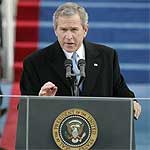
Reflections on the 55th Presidential Inauguration - A Roundup
Labels: politics
Why I enjoy reading Paul Johnson.
Of all the contemporary historians, Paul Johnson is without a doubt the one I most enjoy, especially his quirky sense of humor and turn of phrase. Case in point:
The Marxists never grasped the significance of anti-Semitism either. Here again their minds had been numbed by Marx's narcotic system. Marks had accepted much of the mythology of anti-Semitism in that he dismissed Judaism as a reflection of the money-lending era of capitalism. When the revolution came it was doomed to disappear: there would be no such person as a "Jew." As a result of this absurd line of reasoning, the Jewish Marxists felt obliged to reject national self-determination for Jews while advocating it for everybody else. . . . Seeing the Jews as a non-problem, the Marxists dismissed anti-Semitism as a non-problem too. They thus entered the greatest ideological crisis of European history by throwing their brains out the window. It was a case of intellectual disarmament on a unilateral basis.
From Modern Times: The World from the 20's to the 90's [Revised Edition, 1991].
Monday, January 24, 2005
A (Belated) 'Happy Birthday' . . .
. . . to Apolonio Latar III -- one of the most gifted and brightest "high school Catholic apologists" of St. Blog's parish -- who recently celebrated his twentieth birthday.
Fr. Richard J. Neuhaus on "communio" & respect for the Eucharist
 As for the controversy about pro-abortion Catholic politicians receiving Communion, we must hope that the discussion started will continue. This is not just about pro-abortion politicians. It engages the much deeper question of the connection between "communion" and receiving Communion.
To be rightly disposed to receive the Eucharist is to be in communion with the Church, which includes faithful adherence to the Church's magisterial teaching. Especially in America where there is a multitude of Christian denominations, many Catholics have assumed the Protestant attitude that the local parish is simply their religion of choice. The parish is the local franchise of the Catholic Church, much as they might patronize the local franchise of McDonald's. It is further assumed that everybody has a "right" to receive Communion, just as everybody has a right to purchase a Big Mac. Obviously, this is a severe debasement of "communion" and Communion. In the Eucharist, we receive Christ and Christ receives us, incorporating us into his body the Church, which is, most fully and rightly ordered through time, the People of God in communion with bishops who are in communion with the Bishop of Rome. To be rightly disposed entails confessing whatever in our lives contradicts or compromises that "communion" with Christ and his Church and then receiving absolution. Sadly, the sacrament of reconciliation has fallen almost into desuetude in many places, and certainly not only in the United States. One, therefore, must hope that the election-year controversy over pro-abortion politicians will lead to a much more comprehensive renewal of Catholic understanding and practice with respect to authentic "communio." Excerpt from Zenit's interview w. Fr. Neuhaus "On the Eucharist and Its Relationship to "Communio" January 23, 2005. Questions for further reflection and discussion:
Labels: politics
Sunday, January 23, 2005
Narnia & Lord of the Rings - Staying True to the Word
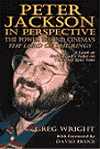 (Via Bill Cork): Peter Jackson In Perspective: The Power Behind Cinema's the Lord of the Rings, a book by Greg Wright, contributing editor for HollywoodJesus.com (and manager of their Lord of the Rings section). For a preview, see "Looking at Tolkien trilogy in a new way" (Naples Daily News January 22, 2005), about a roundtable discussion between Peter Jackson & company with "religion news specialists" and film critics. (Via Bill Cork): Peter Jackson In Perspective: The Power Behind Cinema's the Lord of the Rings, a book by Greg Wright, contributing editor for HollywoodJesus.com (and manager of their Lord of the Rings section). For a preview, see "Looking at Tolkien trilogy in a new way" (Naples Daily News January 22, 2005), about a roundtable discussion between Peter Jackson & company with "religion news specialists" and film critics.Jackson and co-writers Fran Walsh and Philippa Boyens knew that Tolkien's traditional Catholic faith had deeply influenced "The Lord of the Rings." Their goal was to keep the "spirit of Tolkien" intact while producing films for modern audiences. They said they had vowed not to introduce new elements into the tale that would clash with Tolkien's vision.
"You would have to say that these are extremely gifted people and that they showed incredible dedication and integrity," said Wright. "But the questions remain: What is the spirit of Tolkien? How well do Jackson, Walsh and Boyens understand the spirit of Tolkien?" Read the article and judge for yourself. It's rather amazing how Tolkien's distinctly Catholic spirituality managed to survive (to some extent) on screen -- despite the fact that the director, screenwriters (and ja good portion of the cast) did not share Tolkien's religous worldview. In fact, judging from their comments below, Jackson and co-writers Fran Walsh and Philippa Boyens can at best be described as espousing a rather lukewarm humanism: Jackson was blunt: "I don't know whether evil exists. You see stuff happening around the world and you believe it probably does. . . . I think that evil exists within people. I don't know whether it exists as a force outside of humanity."
Walsh and Boyens emphasized that the books are about faith, hope, charity and some kind of life after death. What about sin? "You don't fall if you have faith," said Boyens, and true faith is about "holding true to yourself" and "fellowship with your fellow man." "Lord of the Rings," she said, is about the "enduring power of goodness, that we feel it in ourselves when we perceive it in others in small acts every day. ... That gives you reason to hope that it has significance for all of us as a race, as mankind, that we're evolving and getting better rather than becoming less, diminishing ourselves through hatred and cruelty. We need to believe that." I agree with Wright's assessment: "I think that you can find Tolkien's vision in these movies if you already know where to look. But if you don't understand Tolkien's vision on your own, you may or may not get it." I imagine a lot of kids who will see the films as pure and simple fantasy, a glorified Dungeons & Dragons adventure on the big screen, and nothing more -- certainly impressive, but quickly forgotten as they move on next summer's blockbuster. Of course one would hope they would be sufficiently enticed to read the books. 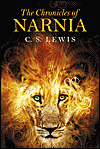 The issue of faithful translation are raised by Walt Disney Studios' production of C.S. Lewis' The Lion, The Witch and the Wardrobe -- part of what may become a film adaption of the entire Chronicles of Narnia. C.S. Lewis' Christianity seems to me even more explicit in his writing than Tolkien's. Even as a first grader, it wasn't hard to discern the allegorical sense of the passion, "crucifixion" and resurrection of Aslan the Lion. So when I heard it was being produced by Disney Studios (in its latter days hardly a haven for Christian morality), and by the director of Shrek, who is reported to have said: "I don't want to make a movie based on the book. I want to make a movie based on my recollection of the book" (MoviesOnline.ca). Granted, the directors must be granted a certain amount of creative liberty filling in the details. But my initial thought was that the cinematic version of Narnia -- in the hands of Disney -- would only appear on screen after having undergone a drastic de-Christianization under the scrutiny of the Grand Enforcers of Political Correctnesstm. However, my confidence is boosted by the discovery that C.S. Lewis' stepson Douglas Gresham is serving as co-producer, with the specific intent on seeing that the movies stay true to the stories of his father, as well as by this report from NarniaWeb.Com: Is this going to be a secularized Hollywood version or will C.S. Lewis' Christian themes stay intact? - It's no secret that C.S. Lewis was an outspoken Christian and his faith was woven throughout everything he wrote. Narnia is no exception and much of the stories are allegorical in nature. Will Hollywood have its way and strip out Lewis' spiritual messages? Not so, promises Douglas Gresham, co-producer and stepson of Lewis himself. A committed Christian, Gresham has vowed not to “change the words of the master.” Indeed, Walden Media itself has a track record of family-friendly films so it seems that the film will be in good hands. Many are concerned that Disney's influence will water down the Christian themes which run through the Narnia stories, but it's important to remember that Walden Media is ultimately in charge of the film, not Disney.
Richard Taylor and WETA Workshop -- chief special-effects, weapons and armor architects of Peter Jackson's Lord of the Rings -- is developing the creatures and the world of The Lion, The Witch, and the Wardrobe. An impressive featurette on their handwork bringing Lewis' world to life is now online. The film is scheduled to be released on December 9, 2005. Related Links:
Labels: cinema
Saturday, January 22, 2005
Remembering Roe v. Wade
Labels: politics
Thursday, January 20, 2005
Further Reflections on Islam
One of my readers takes issue with the subject of yesterday's post (Muslims and the Virgin Mary, January 19, 2005), alleging that I may have succumed to sentimentality in recognizing the Islamic appreciation for Mary:
We have, in my opinion, this sentimental idea that honoring Mary is the common denomintor between Catholicism and Islam. Somehow Mary is to be our Trojan horse. I suggest it is rather the other way around. Mary in the Koran is cut out to be their Trojan horse in converting Christian territory to Islam. And maybe that happened already centuries ago in the spread of Islam. It might happen again through sentimentality. Trust me, Ccaroline, I have no illusions about the dangers of militant Islam, or the threat it poses to the West. Neither, for that matter, does Fr. Cizik, who -- if you read his essay "Our Lady and Islam" -- writes his article fully conscious of the decades of historial conflict between Islam and Christianity, and actually points to the instrumental power of the rosary (at the behest of St. Pope Pius V) in driving back the Islamic hordes at the battle of Lepanto. But here is my motivation for posting, in case you were wondering: As you probably know by now, this week also witnessed the brutal murder of an Egyptian Christian family at the hands of Muslims in what, by initial appearances and reports, was a religiously-motivated crime of hatred -- not in the Middle East but on our home soil, in a New Jersey neighborhood. There's been much discussion of this story by Christian bloggers -- on Open Book. Many took this as justification for their wholesale indictment of Islam as a religion, to portray all Muslims as inherently suspect. Catholic blogger El Camino Real took the incident as an occasion to call for religious discrimination against Islam in general: It is certainly time to act. America is no place for the violence and barbarism of the Mohammedan religion. Perhaps an amendment to the Constitution is in order ... As one commentator observed, "Being a lifelong Protestant who grew up in the Bible belt I thought it was ironic to see people on a Catholic website discussing Islam in the same terms I have heard Catholicism discussed." As I had written in a previous post: . . . There [are] two faces to Islam -- there is the violent face of radical militant Islam which, post 9/11, is at the forefront of the public conciousness. There is another face of Islam, which is manifested in religious devotion, works of charity, and spiritual teachings which any Catholic would find worthy of approval. The former has fueled the hatred of terrorists; the latter has inspired many great teachers and saints. It is truly unfortunate that both faces are called "Islam", and I was disturbed by the fact that certain bloggers were giving almost exclusive attention to one face and neglecting the other. Of course I am not the only member of St. Blog's Parish to be disturbed by this inclination to engage in a wholesale condemnation of the Islamic faith. In July of 2004, Fr. Tucker (Dappled Things) took issue with the assumption that one's self-described belief in Islam marks him ipso facto as being of suspect loyalty. Or that Islam in none of its manifestations can ever be compatible with Western secular civilization. Or that immigration into the West from Muslim nations is an unmitigated threat and can never mean anything but trouble. These are the fears that drive Frenchmen to ban headscarves. The present conflict with militant Islamic fundamentalism should not, in my opinion, preclude Christians from recognizing areas of mutual agreement and grounds for cooperation with fellow Muslims. If in asserting such I am guilty of sentimentality, so is Pope John Paul II, Cardinal Ratzinger, Cardinal Arinze, and many others -- and I would be honored to be among such company. With regards to yesterday's post, I have no reason to impute devious "trojan horse" intentions in Mustafa Aykol's disgust with two French Catholic writers for abandoning their belief in the Virgin Mother. Rather, I take it as grounds for what I would hope to be a positive conversation -- something to consider precisely at this time when the predominant inclination is to invoke a general condemnation of Islam. Recent arrivals to my blog can read my earlier posts on Islam here:
And for those who are interested, a compilation of articles and essays (critical as well as appreciative) on Muslim-Christian Relations. Labels: islam
Wednesday, January 19, 2005
Muslims and the Virgin Mary
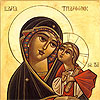 (Via Katolic Shinja). Mustafa Aykol, "a political scientist, journalist, and freelance writer from Istanbul, Turkey" takes two contemporary French Catholic(?) authors to task for denying the virgin birth (In Defense of Mary the Virgin. IslamOnline.net, January 18, 2005): (Via Katolic Shinja). Mustafa Aykol, "a political scientist, journalist, and freelance writer from Istanbul, Turkey" takes two contemporary French Catholic(?) authors to task for denying the virgin birth (In Defense of Mary the Virgin. IslamOnline.net, January 18, 2005):Christians be Christians! -- In a world where dedicated atheists come to realize the existence of "a super-intelligence" that shaped the natural world, it is surprising to see “Christians” who deny that the “super-intelligence” in question has intervened in history.
Here, then, we have mainly a theological problem, but also a practical one. As a Muslim, I see Christianity as my ally in the effort to redeem this misguided world—misguided by many forms of materialism, hedonism, lust, and arrogance. But I want to see my allies firm in their faith. And, of course, many of them are. But for those who are not, may I point out what the Qur’an says about Christians: [The people of the Gospel should judge by what God sent down in it. Those who do not judge by what God has sent down, such people are deviators/] (Al-Ma’idah 5:47) The denial of the virgin birth and other miracles is such a deviation. We Muslims have to—and definitely will—stand against it. I wonder if this Muslim has heard of Hans Kung or the Episcopalian Bishop John Shelby Spong?
Labels: islam
Tuesday, January 18, 2005
Sunday, January 16, 2005
Karl Keating: Crisis Magazine in Crisis?
 In his January 5, 2005 edition of his email newsletter, Catholic Answers' apologist Karl Keating expressed his concern with "politics and the Catholic magazine"; more specifically, Crisis magazine, and what he perceives as a dangerous preoccupation with political matters. In his January 5, 2005 edition of his email newsletter, Catholic Answers' apologist Karl Keating expressed his concern with "politics and the Catholic magazine"; more specifically, Crisis magazine, and what he perceives as a dangerous preoccupation with political matters.
According to Keating: "Catholicism in Crisis" ran articles about Catholicism in crisis. The 1986 name change did not see a major change in focus. Two decades ago the magazine was mainly a vehicle for the critique of the wider, secular culture, secondarily an analyzer of the way that culture impacted the Church (for the worse, mostly). There were articles that were overtly political, but they were the exception.
About a decade ago the emphasis changed. The magazine moved from South Bend to Washington, and Deal Hudson became involved in Republican politics, which meant Crisis also became involved in Republican politics. . . . While welcoming the general idea of a liason from Catholics to the Bush administration, Keating also wondered: "should the liaison be the head of a Catholic magazine that might need to editorialize against Administration policies?" As Keating expected, the move provoked accusations of partisanship and accusations that Crisis was merely "a Republican house organ" -- a charge that Crisis itself bolstered ("I can't recall anything in the magazine that criticized the Bush Administration but plenty that criticized its opponents"). The problem was compounded last year after the National Catholic Reporter ran an investigative report -- or what I thought to be a clear case of attack-dog journalism -- about Deal Hudson's involvement in a sexual affair as a professor at Fordham University. Although the incident occurred over a decade ago, the scandal it caused was enough to prompt Deal's resignation as liason to the White House and ultimately to relenquish his position at the magazine. Keating goes on to voice his criticism of an article "Biting the Bullet: Military Conscription and the Price of Citizenship", by Francis X. Maier, former editor of the National Catholic Register. For Keating, Maier's assertion that "America was an empire in denial" was a poignant example of Crisis went wrong, and why he considers it now to be not so much a distinctly Catholic magazine as a kind of "National Review with a largely Catholic authorship": What especially bothered me about the article is that there is nothing particularly Catholic in endorsing imperial designs, and there is nothing particularly Catholic in universal conscription. Granted, a Catholic can be for them and still be a Catholic in good standing--but a good Catholic also can be against them. My own position is against having America be an empire and against conscription. You may differ. Fine. Let's agree to disagree.
But why should a Catholic magazine come down so strongly in favor not just of the draft but of a wider, universal conscription to various forms of social service? Why should it go further and implicitly endorse imperial designs? And why should it neglect to run simultaneously an article opposing both positions? There is no Catholic dog in this fight. If the Church permits good Catholics to take one side or the other, isn't there an imprudence in pushing only one side? . . . I wince when I see "Crisis" endorse a position where no position needed to be endorsed and where faithful, orthodox Catholics are free to disagree. I winced when the magazine moved to Washington and changed its focus from culture mixed with some politics to politics mixed with some culture. I think it was an imprudent geographic move that, as I feared, has resulted in too much trucking with the political establishment. Keating's criticisms of Crisis is appropriate and necessary, and there is much in Crisis's choice of articles that merit his remarks. On Amy Welborn's Open Book, several commentators expressed their suprise that Keating neglected to mention the cover story for Crisis October 2004: "The Case for American Empire", a bombastic article by H.W. Crocker III with the opening assertion that "every Catholic should by rights be an imperialist." (Readers might recognize Crocker as the author of Triumph: The Power and Glory of the Catholic Church, which I read last year and gave a mixed review. I'm not really a fan of Crocker's writing and find it rather offputting. Fortunately, most contributions to Crisis are more substantial and consideraly less obnoxious). While I like the idea of those in the White House reading Crisis alongside the National Review and The Weekly Standard, I share Keating's concern about the dangers raised by the chief liason between Catholics and the White House being at the same time the publisher of a prominent Catholic magazine. It's a very precarious position to be in -- especially if, like Hudson, you're involved in the "culture war" against sexual immorality with a skeleton in your closet. Nevertheless, I'd dispute Keating's presentation of Crisis as a magazine overly preoccupied with politics. Despite it's occasionally questionable choice in articles, or one-sided presentation of positions which allow for a diversity of Catholic opinion (such as U.S. foreign policy), I find it to be overall a very well-rounded Catholic periodical with a broad selection of subjects and contributors -- politics and morality, yes, but a great deal more. Consider the chief stories over the past year alone:
It is to be expected that Crisis will focus on subjects of a political and moral nature, especially at a time when the public's attention is focused on legislation concerning key moral issues such as abortion, stem-cell research, gay marriage, and euthanasia. Despite Keating's valid concerns, however, it seems to me that Crisis has nevertheless held to a pretty balanced diet of subjects. In fact, as much as I enjoy reading National Review, Weekly Standard and Commentary, I've found Crisis' diversity a welcome respite from the political chatter. And under the helm of newly-established editor Brian Saint-Paul, I hope that it will stay its course. A good compliment to First Things (still my favorite), and a necessary counter to the decidely more liberal views of Commonweal.
Friday, January 14, 2005
Fr. James Schall on "When War Must Be The Answer"
It has been the fault of both pacifism and liberalism in the past that they have ignored the immense burden of inherited evil under which society and civilization labour and have planned an imaginary world for an impossible humanity. We must recognize that we are living in an imperfect world in which human and superhuman forces of evil are at work and so long as those forces affect the political behaviour of mankind there can be no hope of abiding peace.
Christopher Dawson, "The Catholic Attitude to War," 1937 Last year George Weigel wrote a brief article on just war theory ("Force of law, law of force", The Catholic Difference April 2003), in which he stated that: The juxtaposition of "the force of law and the law of force," a trope that got established in the Catholic conversation months before armed force was used to enforce disarmament in Iraq, will likely be a prominent feature of the post-war Catholic debate. . . . The "force of law/law of force" juxtaposition neatly divides the world into two camps. Those who wish to settle conflicts through diplomacy, political compromise, and the mechanisms of international law live on one side of this Great Divide; those who believe in using armed force are on the other. Given that dichotomy, the moral choice seems clear: the first camp. The problem, which involves both content and context, is that the world doesn’t work the way the trope suggests. . . . Is the relationship between international law and armed force a zero-sum game, such that every use of armed force necessarily entails a loss for the "force of law"? Fr. James Schall revisits this topic in "When War Must Be The Answer" (Policy Review No. 128., December 2004), in which he delivers a broadside to "war is not the answer" protestors in a substantial reflection on the justifiable use of armed force, just war theory, and the war on terrorism. My recommmendation would to be read Schall's essay alongside just war scholar James Turner Johnson' latest piece in First Things: "Just War: As It Was and Is" (No. 149, January 2005). For the sake of a counter-argument, see this essay on just war theory by brother John Raymond of the The Community of The Monks of Adoration, recommended by Fr. Jim Tucker. As an intellectual/academic exercise, compare Brother Raymond's presentation of just war theory and his predisposition towards pacifism with the critiques of Father Schall and James Turner Johnson. I was going to write an extended essay on this myself, but I find that between Schall and Johnson, there's very little that I could contribute to the debate.* * Besides, I had made the claim two posts earlier that "blogging may be light." ;-)
Thursday, January 13, 2005
Pope Pius XII - Vindicated Yet Again?
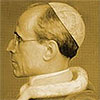 Addendum to the previous posts on Pope Pius XII kidnapping charge (The Guardian's Attempt to Slander Pope Pius XII 12/30/04, and "Pius XII, Pope John XXIII and the Jews" 1/2/05). According to Zenit.org: Addendum to the previous posts on Pope Pius XII kidnapping charge (The Guardian's Attempt to Slander Pope Pius XII 12/30/04, and "Pius XII, Pope John XXIII and the Jews" 1/2/05). According to Zenit.org:The latest in a series of accusations about Pope Pius XII's behavior vis-à-vis the Jews and Nazi persecution seems to have little basis in fact.
The latest round began Dec. 28 when an Italian newspaper published passages of an alleged 1946 Vatican document that supposedly aimed to keep baptized Jewish children from being returned to their families. . . . Apparently Italian journalist Andrea Tornielli of the Milan newspaper Il Giornale tracked down the original document on which the allegations were based ("kept in the Centre National des Archives de l'Église de France, archive of the secretariat of the French episcopate, position "7 CE 131"). Further examination by Zenit revealed marked discrepancies between the initial account published by Il Corriere della Sera and the authentic document itself, which reveals that: . . . the text has the seal of the apostolic nunciature of France -- as opposed to what Il Corriere della Sera published, which attributed it to the Holy Office.
ZENIT also verified that the document is dated Oct. 23, 1946, three days later than that mentioned by Il Corriere, and that the terms of the Vatican proposal are very different from what the Italian newspaper had reported. The original document contradicts Melloni's version. It states, in fact, that the children should be returned to their original Jewish families. Regarding "Jewish institutions," which during those months were working in Paris and throughout Europe to transfer children to Palestine, the document states that each case must be examined individually. Source: "1946 Document on Jewish Children Tells a Different Story" Zenit.org. Jan 12, 2005. Zenit goes on to provide further details as to the origination of the document. Suffice to say the document's history vindicates Pius XII, with all the hue and cry of Pius' detractors being for nought. A good lesson to take slanderous reports about the pope with a big grain of salt . . . until all the facts come out. (Thanks Ben Yacchov for the update). Labels: jcrelations
Wednesday, January 12, 2005
Blogging may be light . . .
While I agree with the hilarious IowaHawk that one shouldn't invest too much weight in announcing a respite from blogging ("Telling us "blogging will be light" is sort of like calling up the neighbors to announce you won't be nude sunbathing in the back yard for a while . . ."), blogging may nevertheless "be light" in the coming week(s).
Together with some major projects at work that are keeping me occupied, I've also got some books I've been trying to finish, and a few others I'd really like to start on this year. I will definitely be posting to this and my other blogs on occasion, including Catholics in the Public Square (featuring regular reporting on politics and key figures in Catholic public life by Earl E. Appleby, Jeff Miller, David Schrader, Oswald Sobrino). But should a week pass without any kind of blogging activity, there is no cause for concern. In the meantime, feel free to explore my blogroll, and check out a new blog by an old friend of the Blosser family: Sapor Sapientiae, by Kirk Kanzelberger, and his first post: "Smart people and believing in God".
Sunday, January 09, 2005
Thomas Merton Revisited
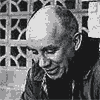 I came across (and posted) this excerpt from Merton's journals last year, but in light of the reception of my recent post, I think some of my (newer) readers would find it interesting: I came across (and posted) this excerpt from Merton's journals last year, but in light of the reception of my recent post, I think some of my (newer) readers would find it interesting:In the climate of the Second Vatican Council, of ecumenism, of openness, the word "heretic" has become not only unpopular but unspeakable -- except, of course, among integralists, who often deconstruct their own identity on accusations of heresy directed at others.
But has the concept of heresy become completely irrelevant? Has our awareness of the duty of tolerance and charity toward the sincere conscience of others absolved us from the danger of the error ourselves? Or is error something we no longer consider dangerous? I think a Catholic is bound to remember that his faith is directed to the grasp of truths revealed by God, which are not mere opinions or "manners of speaking," mere viewpoints which can be adopted and rejected at will -- for otherwise the commitment of faith would lack not only totality but even seriousness. The Catholic is one who stakes his life on certain truths revealed by God. If these truths cease to apply, his life ceases to have meaning. A heretic is first of all a believer. Today the ideas of "heretic" and "unbeliever" are generally confused. In point of fact the mass of "post-Christian" men in Western society can no longer be considered heretics and heresy is, for them, no problem. It is, however, a problem for the believer who is too eager to identify himself with their unbelief in order to "win them for Christ." Where the real danger of heresy exists for the Catholic today is precisely in that "believing" zeal which, eager to open up new aspects and new dimensions of the faith, thoughtlessly or carelessly sacrifices something essential to Christian truth, on the grounds that this is no longer comprehensible to modern man. Heresy is precisely a "choice" which, for human motives . . . selects and prefers an opinion contrary to revealed truth as held and understood by the Church. I think, then, that in our eagerness to go out to modern man and meet him on his own ground, accepting him as he is, we must also be truly what we are. If we come to him as Christians we can certainly understand and have compassion for his unbelief -- his apparent incapacity to believe. But it would seem a bit absurd for us, precisely as Christians, to pat him on the arm and say "As a matter of fact I don't find the Incarnation credible myself. Let's just consider that Christ was a nice man who devoted himself to helping others!" This would, of course, be heresy in a Catholic whose faith is a radical and total commitment to the truth of the Incarnation and Redemption as revealed by God and taught by the Church. . . . What is the use of coming to modern man with the claim that you have a Christian mission -- that you are sent in the name of Christ -- if in the same breath you deny Him by whom you claim to be sent? Thomas Merton Conjectures is a compilation of Merton's notes and spiritual reflections during the 1960's, and was first published in 1968, the same year Merton had, according to Msgr. Michael J. Wrenn and Kenneth D. Whitehead, "drifted away from the faith" and had fled to Asia to become a Buddhist. As Teófilo (Theophilus) (Vivificat) noted in his comments on my original post, "Theologically, though, one needs to read Merton's journals to get the feel on how conservative he really was. Again, the key is found in his journals." On the subject of "Vindicating Thomas Merton," Teófilo posts another remarkable excerpt from Merton's journals (June 6, 1965), in which he specifically comments on his "interest in the East." What Merton says in response is in itself an affirmation of the 'Christo-centric' nature of his reflections, even in the very last months of his life. Labels: merton
Saturday, January 08, 2005
The Pontificator on "Ecclesial Relativism"
Pontifications on "The Triumph of Ecclesiastical Relativism":
Ecclesiological relativism is the logical consequence of the popular anti-sacramental, neo-gnostic understanding of justification by faith that now appears to be dominant in American Christianity. It depends, in other words, on a heresy. According to this popular heresy, we are justified by our internal acts of assent and trust in Jesus, apart from the mediation of the Church. . . .
Father Jim Tucker concurs: I strongly believe that the biggest problem within Christianity today is not the debate over Scripture's authority, or abortion, or the challenges of preaching in different cultural contexts, or homosexuality, or the role of women, or power sharing, or how to get traditional moral laws to speak to the unique condition of the modern world: the single biggest problem and the root of countless errors is flawed ecclesiology.
Remembering Elvis' Birthday
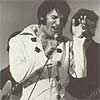 If you would have told me 20 years ago that I'd be an Elvis fan I would have burst out laughing, but it didn't take long to cultivate an appreciation. (The same could be said for country music). If you would have told me 20 years ago that I'd be an Elvis fan I would have burst out laughing, but it didn't take long to cultivate an appreciation. (The same could be said for country music).
Turner Classic Movies brought in the New Year with some classic concert films, including Elvis on Tour and Elvis: That's The Way It Is. The latter chronicles Elvis' 1970 concert series in Las Vegas, following the show's genesis from rehearsal to stage. While the performance is very impressive, the highlight of this movie was the intimate footage of Elvis' rehearsals with his bandmates, backup singers and orchestra, capturing his genuine charm and character. The Curt Jester offers two amusing posts in honor of what would be Elvis' 70th birthday (Janary 8). And on that note, here's a post of mine from last year: "Remembering The King", with a look at Elvis' roots in gospel music.
The Neocons - Apologists for Free-Market Utopianism?
A friend inquired by email what I thought of Pat Buchanan's remark in his Godspy interview that the Catholic "neoconservatives" (George Weigel, Michael Novak, Richard J. Neuhaus) were "the altar boys of a sect that holds, heretically, that free market-democracy is mankind's salvation."
My response was that a comment like that is such a gross distortion (actually, outright falsehood) of Novak and Neuhaus that I wonder if Buchanan -- like certain members of the Catholic left -- had actually read their books. When I was in college I was a bit of a radical lefty anarchist sort -- anti-imperialist, anti-capitalist, heavy imbiber of Chomsky & Howard Zinn, little bit of Marx, Nietzschian nihilism thrown in for good measure. You might be familiar with the type. I read a lot of criticism about conservative thinkers (or neoconservatives) in those days, but as far as I can recall, didn't find much time to actually READ them. It wasn't until after college that I actually picked up Novak's books from the library, along with Fr. Neuhaus, and what I encountered hardly compared to the crude little caricatures I'd fashioned in my mind.
If you're interested in what the "First Things crowd" has to say on this topic, I'd personally recommend Doing Well & Doing Good: The Challenge to the Christian Capitalist, by Fr. Neuhaus, which I'm presently re-reading -- his reflections on the topic occasioned by Pope John Paul II's encyclical Centesimus Annus and The Catholic Ethic & the Spirit of Capitalism, by Michael Novak -- if you don't mind reading used books, you can find both for affordable prices at Amazon.com. Read them and judge for yourself, but don't let the spurious rantings of disgruntled critics prejudice your opinion. Lastly, on the popular conception (or slur, rather) of Novak as apologist for "unbridled capitalist greed," it has always been Novak's contention, as far as I read him, that the very success of the free market and liberal democracy is contingent on the degree to which it embodies the moral virtues of Christianity. Regarding Buchanan's charge of material utopianism, consider the following: A capitalist system is only one of three systems composing the free society. The economic system is checked and regulated by both of the other two systems: by the institutions of the political system and by the institutions of the moral/cultural system. Capitalism does not operate in a moral vacuum. Those who fail to live up to the moral standards implicit in its own structure are corrected by forces from outside it. Thus, capitalism supplies only some of the moral energy present in the free society as a whole. There are moral energies in the democratic polity to call it to account. And there are moral energies in families, in the churches, in journalism, in the cinema, in the arts, and throughout civic society to unmask its failings and to call it to account. This is as it should be. For the free society is not constructed for saints. There are not enough saints on earth to people a free society. A free society must make do with the only moral majority there is — all those citizens called to a noble destiny, indeed, but often weak, tempted, egocentric and quite imperfect. In imagining the free society of the future, it is important not to be utopian. This century has built too many graveyards in its so-called utopias. The citizens of the 2lst century will warn one another against the mistakes of the 20th. In addition to systemic checks and balances, there must also be internal checks. James Madison wrote that it is chimerical to imagine that a free republic can survive without the daily practice of the virtues of liberty. A free society depends upon habits of responsibility, initiative, enterprise, foresight, and public spiritedness. It depends upon plain, ordinary, kitchen virtues. Citizens who are dependent, passive, irresponsible, and narrowly self-interested will badly govern their own conduct, and their project of self-government is bound to fail. It is, therefore, a crucial act of statesmanship to identify and nourish the cultural habits indispensable to the practice and survival of liberty. The free society cannot be made to thrive on the basis of any set of moral habits at all. Where citizens are corrupt, dishonest, halfhearted in their work, inert, indifferent to high standards, willing to cheat and to steal and to defraud, eager to take from the public purse but unwilling to contribute to the commonweal, and entirely self-aggrandizing, self-government must fail. Many peoples of the world, in fact, have shown themselves incapable of making the institutions of liberty work. The road to liberty, Tocqueville warned, is a long one, precisely because it entails learning the habits of liberty. Not any habits at all will do. The road is narrow and the gate is strait. From "Wealth & Virtue: The Moral Case for Capitalism", National Review Feb. 18, 2004. See also:
Thursday, January 06, 2005
Should Episcopalians Become Roman Catholic?
Dr. Blosser (a former Episcopalian) gives his answer, drawing upon the insights of John Henry Cardinal Newman and Thomas Howard -- a "must-read."
Wednesday, January 05, 2005
The Effluence of Kung, The Brevity of Ratzinger.
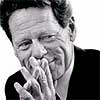 One more note on Dr. Blosser's appraisal of Hans Kung -- I plodded my way through Kung's biography a couple months ago and found it to be a very laborious exercise. Those who have encountered Kung before will recall that he still carries a very large chip on his shoulder against the Church. This was evident in his The Catholic Church: A Short History and is also the case here, as illustrated by subtle (or not so subtle) jabs at his theological rivals. Cardinal Ratzinger, for instance, is described as one who "sold his soul for power in the Church" (a typical perception among many liberal Catholics). One more note on Dr. Blosser's appraisal of Hans Kung -- I plodded my way through Kung's biography a couple months ago and found it to be a very laborious exercise. Those who have encountered Kung before will recall that he still carries a very large chip on his shoulder against the Church. This was evident in his The Catholic Church: A Short History and is also the case here, as illustrated by subtle (or not so subtle) jabs at his theological rivals. Cardinal Ratzinger, for instance, is described as one who "sold his soul for power in the Church" (a typical perception among many liberal Catholics).
Kung's animus towards the Cardinal is nothing compared to the Holy Father, however. Early on in his autobiography, Kung characterizes the young Karol Wojtyla [Pope John Paul II] as a third-rate theologian with "a very thin theological foundation -- not to mention a lack of modern exegesis, the history of dogmas and the church," and alleges that the Holy Father's motive for aligning his papacy with Opus Dei rather than the Jesuits is to get personal revenge for being rejected at the Gregorian (p. 79). For one who back in April 1998 "said he would no longer defend some of his past criticisms of Pope John Paul II, and that he is hoping for a 'conciliation' with the Holy Father" [Source: Adoremus Bulletin], it sounds like he's still got some anger-management issues to work through. A final point of amusement: the focus of Ratzinger's memoirs (Milestones) and Kung's (My Struggle for Freedom) is approximately the same period: their childhood and early years in the priesthood, culminating in their participation as periti (theological advisors) in the Second Vatican Council. Covering the years 1927-1977, Ratzinger says what needs to be said in a mere 156 pages. It's a nice and refreshing read and you can polish it off in an afternoon. By contrast, the first -- wait, there's more? -- volume of Kung's autobiography covers four decades to Ratzinger's five . . . and clocks in just shy of 500 pages (464, not counting the index). I'm not sure what Cardinal Ratzinger's succinctness reveals about his personality. However, after wading into My Struggle for Freedom, I get the impression that Kung is a man who derives great pleasure in talking about himself. Thank God he hasn't taken up blogging!
Karl Barth & Hans urs Von Balthasar
[NOTE: This post is a brief supplement to Dr. Blosser's "The Problem with Hans Kung" (Scripture & Catholic Tradition, Dec. 22, 2004)].
Karl Barth and Hans Urs von Balthasar Barth was reputedly described by Pope Pius XII as "the greatest theologian since Thomas Aquinas" -- a quote I've seen before, usually in Protestant circles, but entirely absent of context. In any case, Hans Kung was not the only one to investigate his works. Fr. Kung's interest in Barth was actually spurred by his doctrinal advisor Louis Bouyer (who advised Kung to read Luther and Calvin on connection with Kung's study of justification), as well as Hans urs Von Balthasar, who had given a series of lecture son Barth in the Winter of 1948-49, later compiled as The Theology of Karl Barth: Exposition and Interpretation. According to Barth's biographer Eberhard Busch, Barth attended Balthasar's lectures when he could "to learn more about myself," and considered Balthasar's work "incomparably more powerful than most of the books which have clustered about me." Balthasar and Kung ultimately ended up in different camps, the former joining Ratzinger and De Lubac in launching Communio, and opposing those who would distort the Council to further the dismantling of orthodoxy; Kung placing himself decidely in opposition to the Magisterium and going on to adopt more and more controversial ("progressive") stances on a number of issues in Catholic theology and morality. Balthasar had his own reasons for studying (and dialoguing with) Barth. These are examined by Edward T. Oakes in the second chapter of Pattern of Redemption), which focuses on Balthasar's critique of Barth's commentary on The Epistle to the Romans -- a text for which The Old Oligarch has little love: "I grit my teeth all the way through Epistle to the Romans. Can you say, 'Radical hatred of the creation?' Why the incarnation isn't obscene to him is beyond me" Balthasar saw something similar in Barth as our fellow blogger, although he didn't put it quite in those terms. According to Balthasar, Barth's emphasis on the complete distinction/opposition between God and man, Creator and creature, when taken to its logical conclusions leads to a parodoxical adoption of pantheism (or precisely theopanism) which abolishes the distinction between creature as creature, and undermines Barth's original position (Oakes, pp. 55-60). Oakes quotes Balthasar: First, God is identified (in all his aseity!) with his revelation. Then the creature is defined as the pure opposite to God and thus is identified with nothingness. And finally, when the creature is retrieved by God through revelation and brought back to God through a dynamic movement (which is an absolute, because divine movement), creation is then equated with God himself, at least in its origin and goal. (Karl Barth p. 84)  According to Oakes, Balthasar's devastating critique of Barth's early thought led him to "an ever greater recognition of the inherent rationality in theology . . . [and the acknowledgement of] the place of analogy in thelogical language." This in fact, says Oakes, is the single most important reason why Barth abandoned his first draft of a dogmatics and started it anew: he realized he was still too influenced by dialectics, and so he still saw God and creation too much as contrasting, even contradictory terms." [Oakes, p. 61] That's enough Barth for one week. (Do check out Oakes if you're interested, however). Labels: hans urs von balthasar
Tuesday, January 04, 2005
The Resurrection, History and (the problem of?) Karl Barth
Dr. Blosser (aka. The Pertinacious Papist aka. "my dad," but I refer to him as "Dr. Blosser" in this context out of respect for his office) has written an appraisal of "post-Chrisian" theologian Hans Kung on his blog "Scripture and Sacred Tradition"
The problem with Hans Kung is that, like the rest of that part of the post-Christian world that has been reluctant to let go of its sentimental attachment to Christianity, he wants to change the meaning of Christianity to conform to his post-Christian commitments rather than to admit that his beliefs are no longer, in any traditionally recognizable sense of the term, Christian. Regarding Hans Kung's fascination with the Protestant theologian Karl Barth, Blosser makes an interesting point that may take some by suprise: [Kung's] Justification: The Doctrine of Karl Barth and a Catholic Reflection shows that he was already interested in drawing converging lines between Catholic and the secularized Protestant theologian, Karl Barth. I realize that many Christians, both Catholic and Protestant, hold Barth in high esteem, viewing him as a champion of "Neo-Orthodoxy" in contrast to the "Liberalism" of demythologizing thinkers such as Rudolf Bultmann, and I realize that they might find my labeling of him as a "secular Protestant" offensive. Yet I make my remarks advisedly. Barth is deceptive. He writes and talks as if he believes in the traditional Christian doctrines. But he doesn't. As University of Edinburgh Professor J.C. O'Neill writes in his chapter on Barth in The Bible's Authority:Barth begins from from the starting-point that none of the miracles in the Bible actually happened. . . . Opponents of Barth like Bultmann were infuriated by Barth's seeming to say that he believed that the resurrection happened (in the normal sense, by which he grave became empty and the transformed body of Jesus left this universe) when he did not believe anything of the sort--but Barth never really concealed his actual position from those who took care to read carefully what he wrote. (p. 273)  Karl Barth on History and the Truth of the Gospel Dr. Blosser's description of Barth as a "secularized Protestant" is indeed suprising, given portrayal as a champion of God's revelation and the objectivity of theology against the liberal subjectivism of Bultmann and 19th century liberal Protestantism. My theology professors in college portrayed him (and praised him) in exactly those terms. But in researching Barth further, I found much to back the credibility of Dr. Blosser's assertion In a survey of "Scripture: Recent Protestant and Catholic Views", Avery Dulles describes Barth's view of scripture as follows (Theology Today Vol. 37, No. 1. 1980): The period between the two world wars was marked by a return to the authority of the Bible without the dogmatic rigidities of classical orthodoxy. The prevailing mood was best expressed by the neoorthodoxy of Karl Barth and his associates, who developed a highly Christocentric view of revelation. According to this school, the word of God was to be identified with Jesus Christ and him alone. The Bible was not itself the word of God but a witness to that word. Christ, however, could address the community through the word of Scripture, and when he did so the Bible became, in a genuine sense, the word of God. The believing community could encounter Christ personally through that word. But it's one thing to say that Barth held to a view of scripture unlike that of his fellow Protestants, quite another to charge that he did not believe in the resurrection in the traditional sense of the term. Consequently, I'd like to devote this post to exploring 1) Karl Barth's thought of the Resurrection itself (as a literal event); 2) Barth's understanding of the resurrection as an event in history; 3) the possible consequences of Barth's views on this subject. Did Barth believe in the Resurrection? Writing in First Things, Ralph C. Wood tells of an evangelical reporter who is alleged "to have asked Karl Barth, when he was visiting this country in 1962, whether he had ever been saved. "Yes," Barth is rumored to have replied. "Then tell us about your salvation experience," the reporter eagerly requested. "It happened in a.d. 34, when Jesus was crucified and God raised him from the dead." ("In Defense of Disbelief" First Things 86 (October 1998): 28-33). In a passionate sermon "Threatened by the Resurrection," Karl Barth describes the resurrection of Christ as not a miracle, but the miracle, the miracle of God - God's incomprehensible, saving intervention and mercy, the all-inclusive renewal that leads from death to life that comes from him, God's life-word, resurrection from the dead! In the same sermon, Barth goes on to challenge those who would reduce this fundamental doctrine of Christianity to something other than it is, interpreting it "not in its literal sense, but . . . a symbol or a human idea": We may be satisfied with this sort of resurrection. We may get along very well for some time with the comfort that death is not so terrible: "One must just not lose one's courage!" We may be satisfied for a long time with the romantic reappearing of the blossoms and the rejuvenation of spring, and thus forget the bitterness of present reality. It may be that, even as we stand beside the graves of loved ones, we find contentment in the thought of a spiritual continuation of this life. But the remarkable thing about it is that the real truth of the resurrection seems to be too strong for us, because it will not suffer itself to be hidden or concealed in these harmless clothes. It always breaks forth; it rises up and shouts at us, asking: "Do you really think that is all I have to say to you? Do you really believe that is why Jesus came to earth, why he agonized and suffered, why he was crucified and rose again on the third day, to become merely a symbol for the truth - which really is no truth - that eventually everything will be all right?" Those who would allege that Barth did not believe in the truth of the resurrection, as a physical event, as the bodily resurrection of Jesus the Christ, will have to wrestle with these words and this sermon -- it seems to me that the burden of proof is on them. However, it is with respect to the resurrection as an event in history that we encounter the problem raised by Dr. Blosser. The Resurrection - a Historical Event? In Contemporary Scholarship and the Historical Evidence for the Resurrection, William Lane Craig briefly describes Barth's view of the subject: . . . Liberal theology could not survive World War I, but its demise brought no renewed interest in the historicity of Jesus' resurrection, for the two schools that succeeded it were united in their devaluation of the historical with regard to Jesus. Thus, dialectical theology, propounded by Karl Barth, championed the doctrine of the resurrection, but would have nothing to do with the resurrection as an event of history. In his commentary on the book of Romans (1919), the early Barth declared, "The resurrection touches history as a tangent touches a circle -- that is, without really touching it." What were Barth's motivations for such a radical claim? According to Gregory W. Dawes (The Historical Jesus Quest Revisited"), Barth's intentions in defending the resurrection as a suprahistorical event -- outside the grasp of historical investigation -- were, to say the least, honorable. Barth's intention was "to undo the damage brought about by historical criticism. . . . [to] reject the idea that a theology could be built on the results of historical research." In particular, says Dawes, Barth was reacting to the claims of liberal theologians like Ernst Troeltsch, that, as simply one religion among others, one cannot take Christianity's claims to authority for granted but must rather submit them to modern historical criticism. Barth and Bultmann, on the other hand, regarded Troeltsch's approach as a betrayal of the properly theological task. They also realized that it was doomed to failure: once Christianity came to be seen as merely one religion among others, its claims to authority would soon be undermined. They, therefore, opposed this development from the very outset. Theologians, they argued, were faced not with "a religion," to be understood in historical terms, but with a divine revelation. Just as there is an "infinite qualitative distinction" between God and the world, so there is an infinite distance between Christianity as a religion and the revelation of which it is a vehicle. The historian might understand the religion, but he or she has no access to the revelation. Revelation can be expressed and understood only in the terms that God himself has provided. 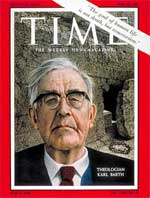 What Barth thought of the resurrection can be gleaned further from "Conversational Theology: The Wit and Wisdom of Karl Barth", by George Hunsinger: . . . Barth's understanding of Christ's resurrection was a recurring topic of interest. An especially interesting exchange took place in an extensive conversation with theology students from Tübingen (pp. 33-52). Curiously, however, one theme never surfaced, even though for Barth it was perhaps the matter of greatest "objective" significance. Unencumbered by modernist arguments about "historicity" (whether pro or con), Barth proposed that, ontically, the significant matter was not so much that the resurrection event was "historical" as that Christ had been elevated from time into an eternal mode of existence without losing his essential temporality. Consequently, the risen Christ, in his saving significance, was able to be the Contemporary of each and every human being, in all times and places. In and through the living Christ, crucified and risen, God related to the entire human race. God's affirmation and judgment of the human race in the life-history of Jesus Christ was the beginning and end of all things. We can judge by Hunsinger's account (and by the words of Barth himself) that Barth did believe in the resurrection, that it was indeed a historical event, but that in light of its utter uniqueness as a "conjunction of historicity and transcendence" it was rendered impervious to subsequent historical investigation. Barth's intent was to counter the negative effects of historical criticism and a liberal Protestant theology that demeaned the truth of the gospel. Perhaps Barth did not anticipate the full implications of his view, or the damaging consequences it was bound to have in succeeding generations of Christian thought. Nevertheless, as Gregory Dawes contends: The work of Karl Barth in particular represents an extraordinary theological synthesis. But its effect on religious thought has been almost entirely pernicious. For Barthian theology has encouraged a "retreat to commitment", a style of thinking which is prepared to defy even the most minimal standards of rationality, standards on which the entire academic enterprise depends. Even on theological grounds, its defiance of historical claims seems untenable, if belief in the incarnation is to be taken seriously. The Jesus of history matters, not just to the historian, but also to the believer. 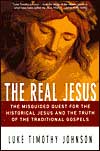 Luke Timothy Johnson's The Real Jesus - Shades of Karl Barth? The Barthian perception of history and what Dawes describes as a "retreat to commitment" bears a remarkable similarity to the conclusions of Luke Timothy Johnson regarding the gospels and historical research, as expressed in The Real Jesus (Harper, 1996) - subtitled: "The Misguided Quest for the Historical Jesus and the Truth of the Traditional Gospels": . . . if the resurrection means, as defined here, the passage of the human Jesus into the power of God, then by definition it is not "historical" as regards Jesus, in the sense of a "human event in time and space." By definition, the resurrection elevates Jesus beyond the merely human; he is no longer defined by time and space -- although available to human beings in time and space. The Christian claim in the strong sense is simply not "historical." The problem in this case is, however, not with the reality of the resurrection. The problem lies in history's limited mode of knowing. Yet, to make one final turn, the resurrection of Jesus in this strong sense can be said to be historical as the experience and claim of human beings, then and today, that organizes their lives and generates their activities. That is the resurrection has a historical dimension as part of the "resurrection community" that is the Church. Johnson proceeds from his observation regarding the limits of historical knowledge to the striking conclusion that history itself can be dismissed in proving the claims of Christianity: Christianity has never been able to "prove" its claims except by appeal to the experiences and convictions of those already convinced. The only real validation for the claim that Christ is what the creed claims him to be, that is, light from light, true God from true God, is to be found in the quality of life demonstrated by those who make this confession. . . . the claims of the Gospel cannot be demonstrated logically, they cannot be proved historically. They can be validated only existentially by the witness of authentic Christian discipleship. I first read Johnson's book in college, and it was a welcome find just at the time I was taking some courses on New Testament biblical scholarship and studying (or being force-fed) the findings of "The Jesus Seminar." As it stands, The Real Jesus provides an excellent critique of scholars like Marcus Borg, Dominic Crossan and Bishop Spong who promote a "historical Jesus" completely divorced from the traditional gospel account. At the same time, I found myself utterly disappointed by Johnson's conclusion pertaining to history and the demonstratable truth of the Gospel. Johnson's emphasis on Christian action is laudable, as is his insistence that one cannnot investigate the veracity of the gospel accounts exclusive of the creedal claims of the Church. However, Johnson's explicit dismissal of history and identification of gospel truth with "the experiences and convictions of those already convinced" -- a blatant retreat into subjective experience as the sole arbiter of religious truth -- must be questioned and firmly rejected. I could be going out on a limb here in noting the similarity between Johnson and Barth, although I expect Johnson was certainly acquainted with his writings. In any case, I was pleased to read that Richard B. Hays expressed similar reservations about Johnson's conclusions in his review for First Things June/July '96). The Heresy of Modernism and the Resurrection While researching this topic I came across the Catholic Enyclopedia's entry on "The Resurrection", the last section of which addresses the resurrection in light of the heresy of Modernism,associated in part with the French theologian and biblical scholar Fr. Alfred Loisy (1857-1940). The underlying propositions of modernism were summarized and condemned by Pius X in the 1907 decree Lamentabili Sane, and in greater depth in Pascendi Dominici Gregis). Among the condemned propositions was the assertion that "[t]he Resurrection of our Saviour is not properly a fact of the historical order, but a fact of the purely supernatural order neither proved nor provable, which Christian consciousness has little by little inferred from other facts." According to the Catholic Enyclopedia: This statement agrees with, and is further explained by the words of Loisy . . . [according to whom], firstly, the entrance into life immortal of one risen from the dead is not subject to observation; it is a supernatural, hyper-historical fact, not capable of historical proof. . . . This faith of the Apostles is concerned not so much with the Resurrection of Jesus Christ as with His immortal life; being based on the apparitions, which are unsatisfactory evidence from an historical point of view, its force is appreciated only by faith itself . . ." Loisy's beliefs were criticized by the Catholic Enyclopedia, which maintains that: the denial of the historical certainty of Christ's Resurrection involves several historical blunders: it questions the objective reality of the apparitions without any historical grounds for such a doubt; it denies the fact of the empty sepulchre in spite of solid historical evidence to the contrary; it questions even the fact of Christ's burial in Joseph's sepulchre, though this fact is based on the clear and simply unimpeachable testimony of history. Of course, one cannot lump together Modernism with Liberal Protestantism. John L. Murpy points out in Modernism and the Teaching of Schleiermacher (The American Ecclesiastical Review July, 1961), while the propositions condemned in Lamentabili are rooted in Liberal Protestantism, there remains an important difference between the two movements: The Modernist attempted to bring into harmony both the traditional Catholic faith and these principles of Liberalism; this would naturally result in a rather distinct system. Obviously, because of the opposite directions taken by the underlying philosophical principles of both systems, this attempt could not possibly have succeeded. It was in reality an attempt to reconcile the irreconcilable, and it could only have ended by the abandonment of one or the other element: either accept the condemnation of Pius X or forsake the Catholic Church. Modernism predates Barth, and the whole of Barth's work is typically depicted as an effort to combat the principles of theological liberalism. Nevertheless, I find it interesting how Loisy's "flight from history" -- denying the relevance of historical investigation in testifying to the truth of the gospel -- is repeated to some degree by Karl Barth, and how Barth's theology has contributed to what Dawes criticizes as a "retreat to commitment," such that even Luke Timothy Johnson ends up soundling a lot like Barth himself. The Postmodern Appropriation of Karl Barth A further sign of concern is the fact that some Protestant scholars have revived (should I say resurrected?) an interest in Karl Barth, not as a defender of traditional Christianity, but as a foundation for "postmodern" theology. In Barth and beyond" (Christian Century May 2, 2001), William Stacy Johnson explores the work of various Protestant authors who have appropriated Barth, announcing: A number of theologians of late, myself included, have been arguing that Barth inaugurates a theological movement that has some affinities with the intellectual currents running through postmodernity. With the revision and republication of the second edition of his Epistle to the Romans in 1922, Barth sounded with piercing clarity the theme that God is simply greater than all the attempts of theologians -- whether liberal or conservative, whether modern, premodern or postmodern -- to capture God within the confines of a single, self-contained framework of linguistic meaning. And in an earlier article, The 'postmodern' Barth? The Word of God as true myth (Christian Century, April 2, 1997), Gary J. Dorrien goes into detail how once the "outdated" ["neo-orthodox"] categorization has been discarded, certain elements of Barth's theology can then be used to bolster a postmodern Christianity: Long after he relinquished the expressionist tropes of his "crisis theology" period, Barth's theology remained a rhetoric of freedom. He refused to reduce God to one element of a system; he rejected every kind of philosophical foundationalism; and his theology blended too many patterns to be reducible to any single theme. . . . Though his massive Church Dogmatics took on the appearance of an old-style dogmatism, his theological vision throughout this epochal work remained distinctively pluralistic and open-ended. "Open-ended", "pluralistic", anti-hierarchical and anti-dogmatic -- such terms are obvious warning signs of entry into a quagmire of postmodernism which eschews a traditional understanding of religious truth. Dorrien made his case for a postmodern reading of Barth in The Barthian Revolt in Modern Theology: Theology Without Weapons, which in turn received a brief mention in First Things: "This is the significance of the "theology without weapons" in his subtitle, which refers to an autopistia or faith that stands on its own without support from philosophy, natural theology, historical demonstration, or ecclesial authority. The upshot, according to Dorrien, is that Karl Barth is in fact a fellow–traveler with the anti–foundationalists of contemporary postmodernism." The reviewer counters Dorrien by appealing to "students of Barth such as Wolfhart Pannenberg and Robert Jenson . . . [who] interpret and react to his work with quite different intentions" -- but one must nevertheless wonder: is there something in the theology of Karl Barth itself that contributes to this dangerously postmodern reading? I admit that since my conversion I have made little effort to keep up with Karl Barth or subsequent Lutheran theology, this post being a rather novel venture into such territory. However, Karl Barth once said "I cannot say that I consider it "cricket" when people talk about something without having properly studied it." And fearing I may be precisely such a person in these circumstances, it is out of deference to Mr. Barth (God bless his soul) that I bring this to a close. This post was originally conceived as a supplement to (and spinoff from) Dr. Blosser's "The Problem with Hans Kung", and I hope his readers might find these further notes helpful. Given the nature of the topic, I would certainly be delighted if perhaps one of our Lutheran (or former Lutheran) bloggers weighed in on this discussion as well -- or even corrected me, if it happens that I erred in my understanding of Barth. I leave you with this amusing fictional dialogue I came across: "How Historical is the Resurrection?", by Daniel L. Migliore (Theology Today Vol. 33, No. 1, April 1976 -- thank God for online archives), beginning: BARTH: Have I ever told you my joke about modern theologians? Bonhoeffer is good beer; Tillich is beer; Bultmann is foam. . . . (In my next post I'll briefly look at Barth's friendship with another Catholic scholar, not Kung, but von Balthasar).
Monday, January 03, 2005
Here and There . . .
Labels: hereandthere
Further Reflections on the Tsunami Disaster
Sunday, January 02, 2005
Cardinal Ratzinger - The Next Pope?
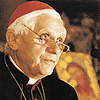 Nothing like the speculation of Time Magazine to boost the usually meager hits on the counter of the Cardinal Ratzinger Fan Club (Rome's Next Choice?, January 2, 2005): Nothing like the speculation of Time Magazine to boost the usually meager hits on the counter of the Cardinal Ratzinger Fan Club (Rome's Next Choice?, January 2, 2005):Joseph Cardinal Ratzinger, the chief architect of Pope John Paul II's traditionalist moral policy, has long been a bugaboo for liberal Catholics. But they had stopped worrying that the German might one day ascend to St. Peter's throne. His hard-line views and blunt approach had earned him the epithet of panzerkardinal and too many enemies. Well, their worrying may now resume. Sources in Rome tell TIME that Ratzinger has re-emerged as the top papal candidate within the Vatican hierarchy, joining other front runners such as Dionigi Tettamanzi of Milan and Claudio Hummes of Sao Paolo. "The Ratzinger solution is definitely on," said a well-placed Vatican insider. I'm a little bit skeptical, to say the least. Cardinal Ratzinger is reported to have twice handed in his resignation as Prefect for the Congregation of the Doctrine of the Faith, "only to be asked by the Pope to stay on" (source). I can't lay claim to inside sources from the Vatican, but I suspect that if the Cardinal had his druthers, he'd like to retire in peace, spending his waning years writing theology texts, playing the piano, enjoying the solitude of the Bavarian Alps. Meanwhile, the Cardinal had previously given his preference that the next Pope "be from Africa", which was interpreted as a support for Cardinal Arinze. Who, I agree, would also be ideal given his firsthand experience dealing with Islam, the liturgy (he currently heads Congregation for Divine Worship and the Discipline of the Sacraments) and interreligious relations (former head of Pontifical Council for Interreligious Dialogue) -- good experience to have, especially in this era. If called to serve the Church in yet another capacity, I'm sure Ratzinger would be up to the task, and I'd personally be delighted by the election of either Cardinal to the office, but I try not to speculate too much. I trust the Holy Spirit to guide our Cardinals in their decision. Hat tip: Bill Cork.
Labels: ratzinger
Pius XII, Pope John XXIII and the Jews
I should have expected it -- but Nathan Nelson has siezed upon the latest story of Pius XII as a vehicle for bashing orthodox Catholics:Nathan: What's even more embarrassing, however, is that some Catholics in the blogosphere are actually defending the actions of Pope Pius XII. It is my belief that if this had not been ordered by a Pope, they would not be defending these actions. But given the latent and heretical belief in papal impeccability among conservative Catholics, they have no choice but to defend the actions of Pope Pius XII. . . . The rationale of these bloggers, and indeed of the Pope and the Curia at that time, is that children who had been baptized Christians could not be given into the care of those who would not educate them in the Christian faith (i.e., their Jewish parents). This position has been taken up by Christopher Blosser from Against the Grain. Some of those commenting on the story over at Amy Welborn's blog, Open Book, are also taking this position." The question of whether Pius XII was right in issuing such a directive is debatable. Nathan is incorrect in characterizing me as "taking up" Pius XII's position -- I did so only in demonstrating how the absence of attention to the theological rationale perpetuates The Guardian's blatant slander that Pius XII was anti-semitic. (I said as much in my post). A lot of over-the-top rhetoric is to be expected in discussing this issue, but I would encourage Nathan to partake in a closer reading of Amy Welborn's blog. I've read through the exchange on Open Book twice and it seems Pius XII's "defenders" are motivated not by a loyal desire to 'defend the Pope at all costs" but rather a nostalgic appreciation for a time when Catholics gave greater weight to what baptism really meant (assuming the baptisms were valid), and the importance of a Catholic education in the salvation of one's soul. Certainly that much can be appreciated, regardless of whether Nathan or I agree with Pius XII's decision. Likewise, I agree with those who find the consequences of such a decision -- the deprivation of children from their parents, or the literal kidnapping of a child in the case . In such cases, the primary mission of the Church ("to save souls" does not, in the words of one commentator, "mean that saving souls is an end to which anything becomes a proper means. Saving souls may be an end without which the Church loses its earthly meaning, without being a licence to make decisions for others that are not given to us to make. St. Thomas might help here on such things as formal and final causes." If you can look past the heated rhetoric and verbal abuse, there is actually a really good discussion of this topic going on by commentators Amy Welborn's blog, with arguments by both sides worthy of consideration and reasoned discussion. Don't take my word for it. Check it out for yourself. It's a tough issue with no easy answer, and I agree with Mark Shea's comment: What seems to me to be missing on both sides of this discussion is any sense that this is a difficult question. For Rad Trads, it's obvious: screw the interests of the parents. They're just Jews, so no big loss. What we need is tough Catholics who tell the unbelieving dog just where his right to mess with our Church ends: at the baptismal font! Oh, for the days when the Fourth Lateran Council kept unbelievers in their place and Catholic enjoyed unquestioned temporal *power*! There appears to be no *serious* consideration of the Person in all this. For the defenders of Roncalli and Woytila, it's equally simple: parental rights trump whatever cloud cuckoo theological issues might be involved. Baptism, sure, is important. But not all *that* important. Not really. Completely absent from this side of the discussion is any serious consideration of "Unless a man hate his father and mother and indeed his very life, he cannot be my disciple". No discussion or consideration of "I come to set father against son and son against father." The notion that Pius might have felt a profound responsibility before God that a child of God not be deprived of their eternal destiny through his neglect seems not to really be entertained. He's simple labeled a "kidnapper" and that's that. It's all white mitres and black mitres. There seems to be no consideration of the possibility that everybody involved was confonted with competing goods. Rather, everybody seems to be talking as though one side (Them) wanted Evil and the other side (Us) wanted Good.  Fulfilling the desired ends of The Guardian's article, Nathan goes on to indulge in some unwarranted speculation of the true intentions of Pius XII and those who baptized Jewish children: Nathan:. . . then again, perhaps the rush to have [Jewish children] baptized was part of a plan to later keep them from their parents -- such would not be beyond the realm of possibility, considering the liturgy at the time and for many years before referred to the Jews as the "perfidious Jews." The Church certainly does have a colorful history of anti-Semitism, and it's not out of the question that curial officials or even Pope Pius XII himself would have wanted to rescue Jewish children from their alleged perfidy. I'll try to be charitable in assuming that Nathan has written this post in an impassioned state and will think otherwise when his temper subsides. But let's look at the reasons why we can refrain from speculating (as Nathan does) that Pius XII's directive was motivated by "true feelings" of hatred toward "the perfidious Jews": We can credit the Church's repudiation of the 'teaching of contempt' which fostered anti-semitism to a Jewish-French professor named Jules Isaac. You can find a summary of how he did so here. Those who have studied the topic will recognize that such a reform could not have occured without the initial help and collaboration of Pope Pius XII. It was by papal authorization in 1949 to translate the Good Friday prayer for the Jews, pro perfidis judaeis with the milder translation "unfaithful" or "unbelieving" that prompted Isaac to obtain an audience with Pius XII, in which: . . . he pointed out that such a change was insufficient, not only because the wording of the new translation was still objectionable, but also because priests continued to use the Latin word, with its damaging psychological associations. [Isaac] urged that nothing but the total suppression of the word could be satisfactory. He also mentioned that Catholics did not kneel for the Jews in the Good Friday devotion. . . . Kneeling for the Jews was re-established in 1955, after nearly twelve centuries. Professor Isaac's work was certainly significant in helping to effect this result.[Preface to The Teaching of Contempt by Jules Isaac, Holt, Rinehart & Winston, 1964]. At the papal audience, Dr. Isaac presented the pope with his scholarship and his Eighteen Points (specific recommendations for the purification of Christian teaching regarding the Jews). He petitioned the pontiff for further changes, and these in turn were addressed by Pius XII's successor, Pope John XXIII. In his book The Hidden Pope, Darcy O'Brien expresses his belief that Pius XII's meeting with Jules Isaac "may even have affected the pontiff's preference for a true reformer, John XXIII, as his successor. Cardinal Deskur, for one, believes this is so." And as Dave Kubiak pointed out (commenting @ Open Book): "it may be useful to recall that on 29 October 1953 at Castelgandolfo, Pius XII held the scarlet galero over the head of Archbishop Roncalli, whom he named Patriarch of Venice." The belief that Pius XII "paved the way for Vatican II" was also held by Jewish convert Msgr. John M. Oesterreicher (1904-1993), a close friend of Cardinal Willebrands and participant in the drafting of Nostra Aetate (His book The New Encounter Between Christians and Jews contains a behind-the-scenes history of the document). Msgr. Oesterreicher describes the revolutionary attitude Pope Pius XII took in the preface to his encyclical on Holy Scripture Divino Afflante Spiritu (my brother Jamie will get a kick out of this, considering it "the greatest papal encyclical ever written"): In his encyclical on Holy Scripture, Pius XII warmly acknowledges that the inquiry of modern exegetes "has also clearly shown the special preeminence of the people of Israel among all other ancient nations of the East . . ." Today, we hear a statement like this without overtones, as something obvious, if not commonplace. In those days, however, with the Nazis in power, to praise the genius of the Jewish people was considered treason, an assault on the purity and grandeur of the Nordic race. Strange though it may seem to men and women of our generation, in the days of Hitler it was a courageous affirmation. He thus helped us become more and more aware of the authentic bond between the Church and the People of Israel. (p. 52) We know very little from the newspaper accounts of the specific circumstances under which the baptisms in question occured, so I believe it would be imprudent to speculate on the motives of the foster parents. We do know, however, what Pius XII thought of "forced conversions." Commenting on Open Book, Steve H. says: Pope Pius XII addressed the charge of "forced conversions" (at least once) in a Papal Allocution on October 6, 1946. He referred to a memorandum dated January 25,1942 which said that conversion must be chosen freely and that there must be an "interior adherence of the soul to the truths taught by the Catholic Church". I found this in Consensus & Controversy by Margherita Marchione. She says that "at times, classes were established to let children study their own [Judaism] religion". She also notes rabbis thanking the Pope for caring for the children. Finally, Nathan ends his post by praising the actions of Pope John XXIII and Pope John Paul II as models of dissent from papal authority: As I mentioned before, as papal nuncio to France, the man who would become Pope John XXIII used his own discretion (that pesky thing called a conscience) and disobeyed Pope Pius XII, returning Jewish children to their families. Apparently, Pope John Paul II also advised Polish families to return Jewish children to their families when he was a priest in Poland. An example of healthy dissent or Christian disobedience that all Christians can be happy about . . . an example of openly defying the direct orders of a Pope in favor of the direct orders of the Gospel. I hope the events I've described above will call into question those who seek to portray Pius XII and John XXIII as simple adverseries with respect to the Jews. Likewise, Nathan should recognize that Fr. Wojtyla was dealing with a different kind of situation, parents who were intending to baptize the child. He wasn't "disobeying" Pius XII in doing so. Nor can one presume he was aware of the directive to retain childrenn who were already baptized -- or that Pius XII would have necessarily disagreed with Wojtyla's actions. The secular media is already having a field day by using this latest story to slander Pius XII as an anti-semite. No sense for Catholic liberal bloggers, whatever their beef is with the Vatican, to join them in doing so. Update:
Labels: jcrelations
Towards a Critical Appreciation of Thomas Merton
 A little more than a year ago, Msgr. Michael J. Wrenn and Kenneth D. Whitehead voice their disappointment with the inclusion of Thomas Merton in the draft of the new National Adult Catechism in an article for Catholic World News (The New National Adult Catechism Revisited CWNews, Nov. 2003). Their article contained a blatantly slanderous and damning portrayal of Thomas Merton as an unfaithful Catholic: A little more than a year ago, Msgr. Michael J. Wrenn and Kenneth D. Whitehead voice their disappointment with the inclusion of Thomas Merton in the draft of the new National Adult Catechism in an article for Catholic World News (The New National Adult Catechism Revisited CWNews, Nov. 2003). Their article contained a blatantly slanderous and damning portrayal of Thomas Merton as an unfaithful Catholic:. . . we now turn immediately to the very first "story" in Part 1, Chapter 1, of the draft NAC, and we find that, incredibly, the supposed "exemplary Catholic" featured in this first story is none other than that lapsed monk, Thomas Merton, a one-time professed Catholic religious, who later left his monastery, and, at the end of his life, was actually off wandering in the East, seeking the consolations, apparently, of non-Christian, Eastern spirituality. Now it is true that Thomas Merton was a gifted writer, which in part explains why he continues to have votaries today; he wrote beautiful words about the needs of the human heart in its search for truth and grace. Some of these words are quoted here, and apparently were the pretext for featuring Merton in this chapter. The chapter is actually richer than that, though, and features at the end some wonderful quotations from St. Augustine. Blogger and fellow member of St. Blog's Parish Bill Cork has recently defended Merton against the slander that he had "left the Church", pointing out that: Merton was not a "lapsed monk," nor a "one-time professed Catholic religious," nor did he ever leave his monastery. He remained a faithful Catholic and a faithful member of the Trappists until he died; he is buried at Gethsemane as "Fr. Louis." He was not "actually off wandering in the East," but went to Thailand for a conference of Christian and Eastern monks, and had other dialogues with leaders of Eastern religions along the way; he died at the Thailand conference when he accidentally pulled an electric fan onto himself. This is simple history known to anyone who knows anything about Merton. Unfortunately, Wrenn & Whitehead's critical article is now suspected as having contributed to the decision of the U.S. Bishops to replace the profile of Merton with American Catholic Elizabeth Ann Seton (the rationale being: "to provide more gender balance, because most of the other profiles [included in the catechism] are of men"). Merton's rejection has sparked protest of hundreds of Catholics, as reported by the Louisville Courier ("Hundreds want Merton back in Catholic guide" January 1, 2005) and monitered by Dan Phillips, who runs a popular website on all things Merton). The International Merton Society has released open letter to Bishop Donald Wuerl, chair of the committee charged with writing the catechism, and USCCB president Bishop William Skylstad, questioning Donald Wuerl's claim that "we don't know all the details of the searching at the end of his life": As for the "secondary" consideration ". . . we are aware of no reputable Merton scholars or even of careful readers of Merton who think that his interest in Eastern religions toward the end of his life, which led to his Asian journey and his untimely death, in any way compromised his commitment to the Catholic Christianity that he had embraced thirty years before. On the contrary, a reading of the major biographies by James Forest, Michael Mott and William Shannon, of The Other Side of the Mountain, the final volume of his journals, of his retreat conferences in Thomas Merton in Alaska, given immediately before leaving for Asia, and of his final talk on the day of his death, published in The Asian Journal, confirm that it was because of the deep grounding in his own Catholic, Cistercian, contemplative tradition that he was able to enter into meaningful dialogue with representatives of other religious traditions like the Dalai Lama, who has repeatedly said that it was his encounter with Merton that first allowed him to recognize the beauty and authentic spiritual depths of Christianity.  If that wasn't enough to persuade Wrenn & Whitehead, let's hear a refutation from Jim Forest himself [photo, left], from a lecture given at Boston College (Nov. 13, 1995): Because Merton was drawn to develop relationships with non-Christians -- Jews, Muslims, Hindus and Buddhists -- casual readers occasionally form the impression that Merton's bond with Christianity was wearing thin during the latter years of his life and that he was window-shopping for something else. It is not unusual to meet people who think that, had he only lived longer, he would have become a Buddhist. But as you get to know Merton's life and writing more intimately, you come to understand that his particular door to communion with others was Christ Himself. Apart from times of illness, he celebrated Mass nearly every day of his life from the time of his ordination in 1949 until he died in Thailand 19 years later. Even while visiting the Dalai Lama in the Himalayas, he found time to recite the usual Trappist monastic offices. One of the great joys in the last years of his life was his abbot permitting the construction of a chapel adjacent to the cider block house that became Merton's hermitage -- he was blessed to celebrate the Liturgy where he lived. If there were any items of personal property to which he had a special attachment, they were the several hand-written icons that had been given to him, one of which traveled with him on his final journey. Few people lived so Christ-centered a life. But his Christianity was spacious. The Dalai Lama has remarked, "When I think of the word Christian, immediately I think -- Thomas Merton!" Merton - Conventional Catholic and Otherwise Whatever position one takes in the present debate, it must be recognized that Merton was anything but a conventional Trappist monk. On one hand, Merton very much catered to such a portrayal as a "traditional" Catholic -- he wrote a spiritual biography heralded as one of the most influential religious works of the twentieth century (The Seven Storey Mountain, 1948); he produced lengthy meditations on traditional Catholic subjects like the Eucharist (The Living Bread, 1956), the Carmelite spirituality of St. John of the Cross (The Ascent to Truth, 1951) and the monastic calling (The Silent Life, 1957). On the other hand, the latter period of Merton's relatively brief life did everything to call his portrayal as a "traditional Catholic" into question: he ventered into political activism in the 1960's (protesting the Vietnam war, racial segregation and the nuclear arms race); displayed a genuine interest in other religions and engaged in dialogue with their practicioners (including D.T. Suzuki, Thich Nhat Hanh, and the Dalai Lhama) in a spirit that anticipated Vatican II's Nostra Aetate, and journeyed to Japan and India to attend conferences on Buddhist-Christian dialogue. There is no denying that the later Merton had changed to some degree in his thought and attitude toward the Catholic Church. In fact, according to Merton's friend Edward Rice, he went on to say I have become very different than what I used to be. The man who began this journal [The Sign of Jonas] is dead, just as the man who finished The Seven Storey Mountain when this journal began is also dead, and what is more, the man who was the central figure in The Seven Story Mountain was dead over and over . . . The Seven Story Mountain is the work of a man I had never even heard of." [The Man in a Sycamore Tree, p 101]. The remark can be interpreted on a number of levels. Rice interprets it as a sign of Merton's disappointment with Trappist life, that it did not bring the peace and contentment he had envisioned when initially becoming a monk. But perhaps Merton's statement can be read as well as a sign of his personal exasperation with Seven Storey Mountain, which propelled him into the public eye and branded him as a kind of "poster boy for American Catholicism" sought after by thousands of adoring readers -- not an easy situation for a Trappist monk attempting to live a life of solitude, seeking to relenquish his ego in the quest for God. However much we may appreciate Seven Storey Mountain, one can also recognize an underlying current of pious revulsion at the secular world, a distinct attitude which laid the groundwork for further change -- as can be seen by Merton's account of his spiritual epiphany en route to the city of Louisville in The Sign of Jonas:The Sign of Jonas: I wondered how I would react at meeting once again, face to face, the wicked world. I met the world and found it no longer so wicked after all. Perhaps the things I resented about the world when I left it were defects of my own that I had projected upon it. Now, on the contrary, I found that everything stirred me with a deep and mute sense of compassion . . . I seemed to have lost an eye for merely exterior detail and to have discovered, instead, a deep sense of respect and love and pity for the souls that such details never fully reveal. I went through the city, realizing for the first time in my life how good are all the people in the world and how much value they have in the sight of God."  The Universal Appeal of Thomas Merton Jim Knight and Edward Rice, two of Merton's close friends, published an online recollections of their memories of Merton -- The Real Merton -- resisting the characterization of their friend as a triumphant Catholic ("a portrait that was unrecognizable, that of a plastic saint, a monk interested mainly in pulling nonbelievers, and believers in other faiths, into the one true religion"). According to Knight and Rice: The Merton we knew, who is still in the lives of both of us, was a different man, and monk, from the saintly person of pre-fabricated purity that has become his image these days. He was a real person, not a saint; he was a mystic searching for God, but a God that crossed the boundaries of all religions; his was not a purely Christian soul. He developed closer spiritual ties than Church authorities will ever admit to the Eastern religions, Hinduism as well as Buddhism. In fact just before his appalling accidental death in December 1968, he was saying openly that Christianity could be greatly improved by a strong dose of Buddhism and Hinduism into its faith. These are things the record needs. Edward Rice, who sponsored Merton's conversion, goes on to challenge what he calls the "Thomas Merton Cult": "['The Thomas Merton cult'] presents Merton as a plastic saint," Rice says, "a contemporary Little Flower, a sweet, sinless individual who has a direct line to God. But the God some people see Merton communicating with is not the God that I think Merton would have been praying to. I am not comfortable with the plastic saint image of Merton; he was no such thing. I see Merton as an individual in the grand scheme, and it makes no difference whether he is approached as a Roman Catholic monk or a Buddhist lama. He was Merton, and he has his influence as Merton." Granted, Rice's vision of salvation may be deemed more universalistic and non-traditional than most Catholics ("in Paradise with Merton, Rice says, are Lao Tse, Isaac the Blind, Ibn el Arab[i], Confucius, Thomas Aquinas, Dorothy Day, Martin Luther King, Charles de Foucau[l]d, . . . "an endless number, hundreds, thousands of saints of all faiths, some with no faith at all"), and I am not altogether certain where such a "Thomas Merton Cult" is to be found (the appreciations I've read of Merton readily acknowledge his defects in character), but I believe he is nevertheless correct in challenging those who seek to claim Merton entirely as Catholic, who could only be appreciated in the context of Catholicism and denying his universal appeal by other religious, or even non-religious folk. Merton's Interest in Other Religions - Two Closing Observations
For one thing, the young Merton was impressed by the spiritual conversion of Alduous Huxley (from materialism to mysticism recognizing "a divine Reality substantial to the world of things and lives and minds . . . [as can be found] among the traditionary lore of primitive peoples in every region of the world, and in its fully developed forms it has a place in every one of the higher religions"), and who was fascinated by Huxley's investigation of mysticism in the world's religions The Perennial Philosophy. Likewise, it was at Columbia University, that Merton met a Hindu spiritual pilgrim -- Bramachari -- who first encouraged him to read St. Augustine's Confessions and The Imitation of Christ, and thus played a part in his journey to Catholicism. Both Merton's encounters with Huxley and Bramachari are described in The Seven Storey Mountain). According to Alexander Lipski (Thomas Merton and Asia: His Quest for Utopia), around the same time he met Bramachari Merton also was reading the Hindu scholar Ananda K. Coomaraswamy (initially in connection with his M.A. thesis on William Blake). Again, to borrow from Bill Cork, much of this is common knowledge to anybody who has studied Merton or has read Merton's biography. I suppose the real question here is not when did Merton begin to study Eastern religions, but rather to what degree did Merton's Catholicism inform and influence his post-Christian exploration of Eastern religions? -- Write and Wrenn have their own conclusions, but so do Robert Forest, Jim Knight, Edward Rice and a number of Merton scholars worldwide. That said, Merton's later writings on other religions -- particularly those on Buddhism -- should nevertheless be read with great care and critical judgement by the laity. Raymond Bailey (curiously, a Southern Baptist minister who became Director of the Thomas Merton Studies Center at Bellannine College in the early 80s) goes into detail as to why this caution is necessary in his study Thomas Merton on Mysticism (Doubleday Image, 1975). It's a little long, but worth repeating in full: Merton's writings on Eastern mysticism are tempered by repeated allusions to traditional Christian symbols. His diaries written in the last months he spent at the hermitage record his preferences for the Fathers for reading in the cottage and for the works of the Zen masters in the fields. However, his published works are not always instructive as to how the Zen experience can contribute to the Christian experience or how the study of Eastern religions or the practice of oriental techniques engender or complement the Christian experience. Some of his published works might well be interpeted as syncretistic and might leave the reader with the im pression that it does not matter what religious expression one's spirituality takes as long as it has broken through the facade of the illusionary self. Should Merton be recognized in the new American Catechism? When it comes to Merton, I find myself agreeing with Robert Royal, on why -- despite his apparent flaws -- we may regard Merton as worthy of praise: Merton's true greatness lies in having engaged in person the whole range of challenges and trials of life in the late twentieth century and yet remaining essentially faithful to his Catholic inspiration. Many of those issues we still confront: poverty and war, the relationship of Eastern and Western thought, and especially how a deep religious life may be lived in contemporary conditions. As we near the end of the century, religion-even contemplative practices-have had a tremendous resurgence. Many of the paths religious people took during the 1960s are coming more and more to look like a dead end. But the attempt to bring a deeper spirituality to the public realm-to say nothing of recovering authentic spirituality-remains a burning necessity. Does Merton deserve placement in the USCCB's Catechism for adult American Catholics? -- I'm inclined to think that Robert Royal might say yes for the reasons stated above, even with due respect to the concerns raised by Merton's interest in Eastern religions. I would answer in the affirmative as well, although I admit here to being a little biased in the matter, since it was through reading Thomas Merton and Dorothy Day that I discovered and was led to the Catholic faith in the first place. I would also question (if the Louisville Courier-Journal is correct) Bishop Wuerl's justification that young people "had no idea" who Merton was -- as if he were an eclectic relic of the early 20th century better swept underneath the rug, whose life and thought simply had no relevance for Catholics of today. Judging by the staying power of Merton in bookstores and conferences on Merton attended by those interested in "the silent life" of contemplation, perhaps Bishop Wuerl underestimates the prevalence Merton has in the hearts of the laity, and his influence (even today) in leading souls to the Catholic faith. Related Readings (Online and In Print):
Saturday, January 01, 2005
2004 - Missionaries Killed in Service to Our Lord
A Penitent Blogger brings us a list, published by Zenit, of missionaries killed in 2004. Here are just a few:
Not all died because of their faith -- some apparently lost their lives for the most vulgar of motives (murdered for a cellphone?). But some appear to be martyrs in the traditional sense of the word, losing their lives because of their proclamation of the Gospel. How casually we take our practice of the Catholic faith for granted; how often we forget those in other parts of the world who risk -- and lose -- their life in service to the Savior. Sometimes I wonder if I could do the same. May God grant that each and every Christian would have this kind of courage if we found ourselves in such circumstances. For all of our missionaries who died this year: Eternal rest grant unto them, 0 Lord. And let perpetual light shine upon them.
Vatican About to Put the Smackdown on . . . Smoking?
Via . United Press International reports:
Vatican City, Vatican City, Dec. 31 (UPI) -- An article in a leading Roman Catholic journal signals that the Vatican may join the public health establishment's crusade against cigarette smoking.
The latest edition of the scholarly publication Civilta Cattolica, published by the Jesuits and approved by a top aide to Pope John Paul II, says smokers cannot damage their own health and that of others "without moral responsibility." The article by Giuseppe de Rosa stops short of calling smoking a sin, but says lighting up is "not neutral either in social or indeed moral terms." LRS ponders: "I wonder if this includes pipes and cigars?" So do I. And what would Chesterton think? (He to whom the quote is attributed: "The Catholic Church is like a thick steak, a glass of red wine, and a good cigar.") And why does the United Press see fit to announce this as "breaking news"?
Pontificator: "Is there salvation inside the Episcopal Church?"
Neither the Protestant understanding of the invisible Church nor the Anglican understanding of the unity of the fractured Church is to be found in the Fathers. The Church is visibly one, and this unity is embodied in baptism, eucharist, and the eucharistic communion of bishops. Precisely because the Church is the divine society ordained by the risen Christ, precisely because of the profound identification between the risen Christ and his mystical body, salvation can only be found in that rightly ordered community of grace to which the promises of Christ rightly apply. The Church Fathers had a lot of experience with schismatic and heretical sects, and they did not hesitate to declare these sects outside the communion of the Church catholic and thus outside the promises of Christ. . . .
Is it not possible, indeed likely, that the Protestant rejection of the ecclesial question is self-serving ideology generated by schism and heresy? Do we dare stake our souls, and the souls of our children and grandchildren, on the churches of the Reformation? We Episcopalians find ourselves in the midst of a theological and ecclesiological crisis. This crisis rightly forces us–or at least should rightly force us–to ask the question of Newman: What is the Church? Are we in the Church? Where is the true Church of Jesus Christ to be found? This is not a matter of idle curiosity. If the Church Fathers are correct, it is a matter of our eternal salvation. We should not bank on our invincible ignorance before the Divine Judge. Leave it to the Pontificator to open a can of worms on New Year's Eve. =) Update: "Is it a safe church to die in?" - Further reflections by the Pontificator, regarding Cardinal Newman's consideration of the matter.
Ashli takes on George Carlin
A blogger named Ashli takes on "comedian" George Carlin -- here's Round 1:
From the beginning of our friendship she never left me and I never left her, and we both came out smiling. That is feminism. Crying at 3 A.M. because another woman held your hand all the way into the abortion clinic is not.
I've got news for George Carlin: if a problem is big enough to "warrant" abortion, it will never be solved by abortion, and women deserve better than the added insult. And check out Round 2 for more of the same (Go Ashli!). Read Ashli's smackdown to Carlin, and then be sure to read this story of a child she saved. There is no more hard hitting and persuasive criticism of abortion than that coming from the unfortunate woman (and, at one time, adamant pro-choicer) who now writes about the devastating consequences of her choice. When I read bloggers like After Abortion and The S.I.C.L.E. Cell, I can only marvel at their courage and honesty -- may their testimony enncourage others to do the same, and win the hearts and minds of young mothers contemplating such a dreadful "choice."
The Hartford Heresies Revisited
On February 10, 1975, a group of 18 Christian thinkers of nine denominations, after a weekend at the Hartford Seminary Foundation in Connecticut, joined in a dramatic warning that American theology had strayed dangerously far afield.
Their "Appeal for Theological Affirmation" condemned 13 pervasive ideas, all of which undermine "transcendence," the essential truth that God and his kingdom have a real, autonomous existence apart from the thoughts and efforts of mankind. Among the signers who were able to agree on the protest with surprising alacrity were Jesuit theologian Avery Dulles, Eastern Orthodox Seminary dean Alexander Schmemann, Lutheran theologians George Forell and George Lindbeck, Yale Chaplain William Sloan Coffin Jr., a Presbyterian, and Evangelical theologian Lewis Smedes of Fuller Theological Seminary. . . . Read more about "The Consequences of Bad Theology" as discussed by Fr. Kenneth Baker, S.J. at Ignatius Insight.
Iraq - Bringing in the New Year with a Prayer
We still dream of a democratic Iraq ruled by the law
And this is something we deserve…this is the land of the first law in history I still find my home in Iraq… it's still the best place in the world in my eyes I will not waste a minute listening to the pessimists Instead, I will add a brick to the house we're building And I will write a word….and pray
I will pray for the ones who fought for the Iraqi freedom Happy New Year. Mohammed, Iraq The Model Labels: iraq
|

Against The Grain is the personal blog of Christopher Blosser - web designer
and all around maintenance guy for the original Cardinal Ratzinger Fan Club (Now Pope Benedict XVI).
Blogroll
Religiously-Oriented
"Secular"
|
||||
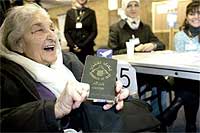
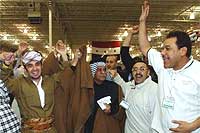
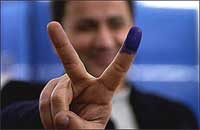 Atheer Almudhafer, from Falls Church, Va., gives the Iraqi sign of victory after casting his absentee ballot at the New Carrollton, Md., voting station, Jan. 28, 2005. His finger is marked with indelible blue ink, intended to prevent double voting. "I give the sign of peace and voting. Together it is victory." [
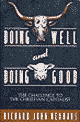

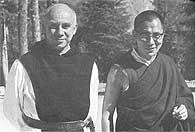 It would be mistaken to assume that Merton's interest in other religions was a post-conversion manifestation of his disappointment with Catholicism, as alleged by Msgr. Michael J. Wrenn and Kenneth D. Whitehead. I question this because Merton displayed an interest in the other religions (especially those of the East) from the time he was a college student at Columbia University.









![[Powered by Blogger]](http://buttons.blogger.com/bloggerbutton1.gif)