Almighty God, our heavenly Father, let thy protection be upon all those who are in the service of our country; guard them from all harm and danger of body and soul; sustain and comfort those as home, especially in their hours of loneliness, anxiety, and sorrow; prepare the dying for death and the living for your service; give success to our arms on land and sea and in the air; and grant unto us and all nations a speedy, just and lasting peace. Amen.
Please Note: Recognition of the following blogs & periodicals should not be considered personal endorsement of the opinions contained therein, especially when content is not consistent with Church teaching.
This Site Adheres to the Welborn Protocol: All correspondence is blogable unless you specifically request otherwise.
DISCLAIMER: The opinions expressed on this blog do not necessarily reflect those held by Pope Benedict XVI or other members of the 'Ratzinger Fan Club' website, which serves as host to this online journal.
No commercial commenting (links to your own blog site or relevant URL's permitted).
Keep in mind I have a day job -- hence, no time to respond to any and all comments. When I do so, it's as time permits.
Lastly, think before you post, and be considerate of others. Your comments may be recorded for posterity -- or the duration of Haloscan's memory.
Thursday, June 21, 2007
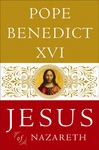
Jesus of Nazareth by Pope Benedict XVIUnlike most Catholic bloggers it seems that I have not yet finished Pope Benedict XVI's Jesus of Nazareth. My progress is hampered by the fact that I'm currently plodding my way through a pile of library books that are beyond the point of extension, and I hope to knock them out by the end of the month.
Consider this the 'anchor' post for this topic, meaning that if I run across any more pertinent links they will be updated here. -- Christopher
Last month, Zenit News Service reported Pope Benedict's Jesus of Nazareth has sold more than 1.5 million copies, the statistic referring to the Italian, Slovenian, Greek, Polish and various English editions. According to Zenit "There are 42 editors worldwide who have agreements to publish "Jesus of Nazareth," and 30 translations are in the works."
. . . The first wave of stories focused on comments in the book about Africa and capitalism, even though they amount to asides in a 448-page treatise on the Gospels. Other stories styled the book as a rebuke to The Da Vinci Code. (That red herring was encouraged by an indirect allusion to Dan Brown's potboiler from Cardinal Christoph Schönborn of Vienna in a Vatican news conference.) Still others seemed charmed by the fact that the pope wrote that because his book is not a magisterial act, "everyone is free to contradict me." Beyond those angles, there was little interest in follow-up, in large part because a pope discussing Jesus strikes most people as the ultimate in "dog bites man" developments -- that is, the most normal thing in the world.
By the time anyone had actually read all 448 pages of Jesus of Nazareth, the moment for further analysis had already passed. Passed, that is, everywhere but here, where papal analysis never goes out of fashion. . . .
and comes to his own conclusions about the Pope's motivation:
What seems clear is that the motive for the book is also emerging as the core doctrinal concern of this pontificate: Christology. Put in a nutshell, Benedict's thesis in Jesus of Nazareth is that there can be no humane social order or true moral progress apart from a right relationship with God; try as it might, a world organized etsi Deus non daretur, "as if God does not exist," will be dysfunctional and ultimately inhumane. Jesus Christ, Benedict insists, is "the sign of God for human beings." Presenting humanity with the proper teaching about Jesus is, therefore, according to Benedict, the highest form of public service the church has to offer.
A Portrait of Faith, by Lisa Miller. Newsweek May 21, 2007. With Jesus of Nazareth, Pope Benedict XVI fights back against 'the dictatorship of relativism' by showing the world his vision of the definitive truth of Christ. (Most amusing sentence: "Liberal Catholics worry that, in spite of assurances to the contrary, Benedict is writing an 'official' biography, and they have cause for concern.")
Theme of papal book may also be hallmark of his papacy, panelists say, by Nancy Frazier O'Brien (Catholic News Service), covering a panel discussion with Bishop William E. Lori of Bridgeport, Conn., and Vatican analysts George Weigel and John Allen, at the Pope John Paul II Cultural Center in Washington on May 15, 2007.
A few months ago someone asked me what book I would recommend that they give to their adult children who no longer practiced the faith, without hesitation I named this book as the one. At the time I had only read some excerpts available online from Germany and Italy. It was an act of faith then, now that I have the book I know that my recommendation was justified.
Jesus of Nazareth: Review by Jeff Miller aka. The Curt Jester May 18, 2007: ". . . The chapter on the Our Father prayer is worth the price of the book alone. This is not just an academic exegesis of the Our Father prayer line-by-line, but a deep meditation into this prayer. Often we can repeat a prayer so often that it looses its freshness and his meditation on this prayer can shock us back into reality of what the prayer that Jesus gave us really means and indicates."
I have just finished reading and it is with some trepidation that I post this message since the blogosphere is cluttered with reactions. It is not my intention to review the work but let me say that I did think it is a powerful book. Those who think it only a work of devotion are mistaken as are those who think his approach to the scriptures is retrograde or those who hail it as the greatest thing since the Summa. . . .
In the Middle Ages rabbis were forced to engage with priests in disputations in the presence of kings and cardinals on which is the true religion, Judaism or Christianity. The outcome was predetermined. Christians won; they had the swords.
But in the post-WW II era, disputations gave way to the conviction that the two religions say the same thing and the differences between them are dismissed as trivial. Now a new kind of disputation has begun, in which the truth of the two religions is subject to debate. That marks a return to the old disputations, with their intense seriousness about religious truth and their willingness to ask tough questions and engage with the answers.
My book, A Rabbi Talks with Jesus, was one such contemporary exercise of disputation, and now, in 2007, the pope in his new book Jesus of Nazareth in detail has met the challenge point-by-point. Just imagine my amazement when I heard that a Christian reply is fully exposed in Pope Benedict XVI's reply to A Rabbi Talks with Jesus in his Jesus of Nazareth Chapter Four, on the sermon on the Mount. . . .
In 1993, then-Cardinal Ratzinger heralded Neusner's book as "by far the most important book for the Jewish-Christian dialogue in the last decade.". Time magazine recently profiled Rabbi Neusner (The Pope's Favorite Rabbi, by David Van Biema. May 24, 2007).
Every so often a book comes along that deeply moves and inspires me as a person, and as a Christian. I can never know when this will happen. Many books disappoint, and many surprise.
I am right in the middle of one of those amazing books. It is “Jesus of Nazareth: From the Baptism in the Jordan to the Transfiguration” by Joseph Ratzinger, otherwise known as Pope Benedict XVI.
OK, I am an evangelical Protestant pastor. How can I speak such of a book by the Roman Catholic Pope of all people? . . .
Time and again, whether he's writing about the temptations, the parables, the Lord's Prayer, or the miracles of Jesus' public ministry, Pope Benedict's method of reading the Gospels puts the edge back on stories and messages often dulled by familiarity. Reading the New Testament through the eyes of Joseph Ratzinger in Jesus of Nazareth thus becomes a way to read the Gospels afresh -- and to be reminded that, whether the New York Times thinks it's "news" or not, the proclamation of Jesus Christ is what the Church is for.
Franz Michel Willam, the Theologian the Pope Has Rescued from Oblivion, by Sandro Magister. www.Chiesa. - Author in 1932 of a famous life of Christ, he had been forgotten by everyone. Benedict XVI cites him in "Jesus of Nazareth," and an Austrian scholar explains why. (Based on unpublished correspondence between the two).
Just months after Benedict XVI released Jesus of Nazareth, the New Testament scholar Gerd Lüdemann has produced this spirited book-length critique of “the Pope’s Jesus.” Lüdemann writes both as a post-Christian who is deeply sceptical about the claims of church doctrine, and as a rigorous advocate of the historical-critical method. A central contrast between Benedict and Lüdemann thus lies in their respective attitudes towards the biblical texts: while Benedict approaches the texts with basic trust and theological commitment, Lüdemann insists that it is “a blind alley” to privilege these texts and to assume that they are historically or theologically trustworthy (p. 23). . . .