Monday, February 06, 2006
Pope Benedict XVI Roundup!
The big news, of course, is the release of Pope Benedict XVI's first encyclical, Deus Caritas Est. For those who've missed it, I've posted a lengthy roundup of reactions and commentary to the encyclical last week. What follows is the usual roundup of various events and Benedict-related material that caught my eye.
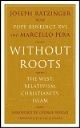 - February 2006 will see the publication of Benedict XVI's latest book, Without Roots: Europe, Relativism, Christianity, Islam, co-authored by Marcello Pera, president of the Italian Senate.
There was a minor flap on Amy Welborn's over the fact that Ignatius didn't get dibs, but as Mark Brumely clarified: "Ignatius Press was asked to take a pass on the book, notwithstanding our ongoing relationship with B 16. Since we already have half a dozen other B 16 projects in the works, we did as we were asked." (Two of those books "in the works" is God's Revolution, an anthology of the Holy Father's addresses during Youth Day; another being Christianity and the Crisis of Cultures, collecting then-Cardinal Ratzinger's addresses on the erosion of Europe's Christian roots). A rather hostile review of Without Roots by Domenico Pacitti has already been posted to justbookreviews.com, while Commonweal's editor(s) provide a brief summary (A Hospitable Place Volume CXXXIII, Number 1. Jan. 13, 2006): Benedict’s concern over the secularization of Europe and his hopes for its re-evangelization are widely known. Without Roots developed from a 2004 exchange then-Cardinal Ratzinger had with Marcello Pera, a secular philosopher and president of the Italian Senate. Pera’s analysis of Europe’s moral malaise is essentially compatible with the pope’s own assessment. Both men think Europe’s alleged loss of identity and vitality requires “primarily cultural remedies,” remedies that can shore up social institutions such as marriage and the family while combating the materialistic and utilitarian biases of science and secular morality. To that end, Pera proposes the cultivation of a “nondenominational Christian religion” or “Christian civil religion.” At first blush, one would hardly expect Benedict to warm to what sounds like a doctrinally anemic version of the faith. Yet he welcomes Pera’s advocacy of a “consensus that, irrespective of membership in a specific faith community, accords a public, sustaining value to the fundamental concepts of Christianity.”Benedict is too grudging in acknowledging the peace, prosperity, and democracy Europe has achieved over the last sixty years, much of it the work of Christian Social Democratic parties. Still, his discussion of the continent’s religious and secular history is provocative, and his high regard for the American tradition of separation of church and state may also come as a surprise. His feel for the dynamism of religious communities in the United States and his critique of the weaknesses of mainline Protestantism has a familiar neoconservative ring to it, but it is good to hear the pope affirm the need for compromise in the political sphere. “The church,” he writes, “does not wish to impose on others that which they do not understand.” Subscribers of First Things have already received a preview, as a chapter was published in the January 2006 issue under the title Europe and Its Discontents.
- On Reading the Pope, Pt. 1 and Part II, by Fr. James V. Schall. Ignatius Insight "Already in reading the remarkable amount of material the present Holy Father writes each week, it is clear, as in the case of his predecessor, that it is a full time job just to keep up with him." Fr. Schall offers a valuable guide to the topics touched on by Pope Benedict in recent letters and addresses.
- Likewise, Providence College assistant professor of biology and adjunct professor of theology Nicanor Pier Giorgio Austriaco lends some assistance Reading Genesis with Cardinal Ratzinger (Homiletic & Pastoral Review).
- Pope Benedict has released his Message for Lent 2006, touching on themes familiar to his first encyclical. Recalling his predecessor's observation that "The temptation today is to reduce Christianity to merely human wisdom, a pseudo-science of well-being." The Holy Father reminds us that
the primary contribution that the Church offers to the development of mankind and peoples does not consist merely in material means or technical solutions. Rather, it involves the proclamation of the truth of Christ, Who educates consciences and teaches the authentic dignity of the person and of work; it means the promotion of a culture that truly responds to all the questions of humanity. . . .The examples of the saints and the long history of the Church's missionary activity provide invaluable indications of the most effective ways to support development. Even in this era of global interdependence, it is clear that no economic, social, or political project can replace that gift of self to another through which charity is expressed. Those who act according to the logic of the Gospel live the faith as friendship with God Incarnate and, like Him, bear the burden of the material and spiritual needs of their neighbors. They see it as an inexhaustible mystery, worthy of infinite care and attention. They know that he who does not give God gives too little; as Blessed Teresa of Calcutta frequently observed, the worst poverty is not to know Christ. Therefore, we must help others to find God in the merciful face of Christ. Without this perspective, civilization lacks a solid foundation. - The Year of Two Popes, by Paul Elie. Readers might recognize Elie as the author of the biography The Life You Save May Be Your Own (Farrar, Straus and Giroux, 2003), an impressive biographical study of Thomas Merton, Dorothy Day, Walker Percy and Flannery O'Connor. Unfortunately, Amy Welborn reviews Elie's article and finds it lacking:
I think what is missing in this piece is an understanding of how serious Christians understand service and discipleship. No one argues that ego can always get injected into the mix, or that motives, even of good people, are always pure and unmixed. But Elie, while not ascribing outright deviousness to Ratzinger, does indeed imply that he was angling for the job of running the Church his own way. But even based on his own evidence, one can come to a very different conclusion, based, as I said, on a different understanding of what should motivate Christians, and, indeed, does motivate many of them: to discern the call of the Spirit to do what is necessary. So if John Paul was unable to engage substantively with visiting bishops, and if ad limina visits are supposed to serve a certain purpose which and if the Pope cannot engage or make use of the information that might come out of those meetings...why should everything come to a halt? Someone needs to step in and hear those concerns and make sure that the process works the best it can under the circumstances. And if, during those meetings, Ratzinger was, indeed, interested and attentive (which is what I've heard , and what Elie reports) - why does that imply that he's interested because he's trying to curry favor or make a good impression in order to serve his own interests - for that is the implication of this article. Why can't it be that Ratzinger truly was concerned and interested? One of the things that has struck me about this Pope since I started reading and paying attention to him, is not just how intellectually deep and adept he is, but of how understanding he is of the human condition, and not just abstractly, but as it is lived in 2006. That "desert" imagery in his homily at his inaugrual Mass sealed the deal for me on that score, and nothing I've heard since has disappointed me. The Catholic Outsider also offers a substantial three-part critical review of the article (The Atlantic and How Benedict was elected January 12, 2006).Rocco Palmo, on the other hand, apparently loved it ("It's worth the five bucks. Don't walk -- RUN . . . Elie's dead-on with his analysis, mostly as he's saying a lot of things I've been saying for months") but points out some discrepancies in Elie's rendering of John Paul's opening of the Holy Door at St. Paul Outside the Walls.
- Pope Benedict to visit the United States in 2007? -- The story began with a comment made by Cardinal Keeler of Baltimore during a radio interview. Rocco Palmo (Whispers in the Loggia) has additional speculation as to the time and motivation for the visit.
- The Vatican has recently reasserted its legal ownership of the copyright to works by Pope Benedict XVI. The news that a Milanese publishing house had already been sent a bill for more than $18,000 to a Milanese publisher for the inclusion of 30 lines from B16's speech to the conclave in an anthology has prompted some to charge the Vatican with "cashing in" [on the Pope's words] (Richard Owen, Times UK Jan. 23, 2005), but Catholic News Service has further details:
. . . in a Jan. 23 statement the Vatican publisher said the introduction to the 124-page book explicitly told readers, "Everything you will find here, after the introduction, comes from the pen or the voice of Joseph Ratzinger," now Pope Benedict.The book was being sold for about $12 a copy, and it was published without the knowledge or consent of the Vatican, the Vatican said. Francesca Angeletti, who handles copyright permissions for the Vatican, told Catholic News Service the Vatican wanted to ensure the integrity of texts attributed to the pope and to prevent publishers from making money off his works without the knowledge of the Vatican and without giving the Vatican appropriate compensation. Newspapers, magazines and bishops' conferences, she said, still may publish papal texts without paying royalties as long as the texts are not changed and a line is included saying the text has been copyrighted by the Libreria Editrice Vaticana. Question: how does this affect the frequent citation of the Holy Father's works by Catholic bloggers and periodicals in the United States?
- On January 8, 2006, Benedict performed the first baptisms of his pontificate, abandoning the prepared texts for the occasion to launch an impassioned denunciation of irresponsible sex and a "culture of death" (Crispian Balmer / Reuters. January 8, 2006). Here is the transcript of Benedict's baptism homily, courtesy of Zenit News Service.
- No place like home: Papal apartment gets extreme makeover, by John Thavis. Catholic News Service January 5, 2006, covering the transformation of the papal apartment, badly in need of renovations. I only mention the article as it notes the Holy Father's reaction to his new library:
. . . while the pope didn't whoop or jump up and down at the unveiling, he made it clear he was pleased with the results.
"I can only admire the things you've done . . . I really like my new library, with that antique ceiling. For me it's like being surrounded by friends, now that there are books on the shelf," he said. The floors were the original 16th-century marble slabs and inlay, restored to their original luster. The library solved the problem of where to put the pope's 20,000 books, which he did not want to leave in storage somewhere. Twenty thousand! -- Oh, to browse the shelves of the Holy Father's personal collection. I know I am not alone in this wish. =)
- Pope Benedict XVI's Emerging Papacy: 'A Service to Joy' - a profile of the Holy Father by Tablet writer Robert Mickens. St. Anthony Messenger February 2006.
- According to a "recent" survey (February 2002), Pope Benedict XVI has written "some 86 books, 471 articles and prefaces, and 32 other contributions." Concentrating on the scholarly works, the Reverend D. Vincent Twomey, SVD, a former doctoral student of the Holy Father, takes on the ambitious task of presenting The Mind of Benedict XVI, The Claremont Review Dec. 23, 2005.
According to Twomey, the "central question" of Benedict's thought on Christianity and the modern world is: "How can Christianity become a positive force for the political world without [itself] being turned into a political instrument and without on the other hand grabbing the political world for itself?" -- Much of Benedict's thought on the respective boundaries of church and state and their interrelationship as presented in Twomey's summary is reminiscent of the latter half of Deus Caritas Est.
- In February of 2005, Sandro Magister speculated that "Among the typically Wojtylian battles that have distinguished [John Paul II's] pontificate, the defense of life is almost certainly destined to continue with his successor as well, unlike other matters that will slip into the shadows, like the interreligious meetings such as the ones in Assisi and the 'mea culpas.'" (Lent in the Vatican: The Pope, the Curia, and the Conclave, www.chiesa Feb. 2, 2005)
The prospect of the Assisi gatherings "slipping into the shadows" was discussed by Bill Cork and myself on this blog (John Paul II, Cardinal Ratzinger and the Lessons of Assisi 1986/2002 Against The Grain Feb. 14, 2005).
Now, Alejandro Bermudez revisits the issue, with a buzz from "Vatican circles that Pope Benedict is thinking of pulling the plug on the interreligious prayer meetings for peace, the last of which took place in Assisi, the birthplace of St. Francis, on January 24, 2002." (Auf Wiedersehen to Assisi? Catholic Outsider January 25, 2006). No sources are cited, but given then-Ratzinger's criticisms of the event as well as the recent conciliatory gestures made towards the SSPX, I wonder if this is indeed a possibility.
- Speaking of the SSPX, John Allen Jr. has The latest on Lefebvrites; Edward N. Peters, JD, JCD (In the Light of the Law) takes a look at the possible reunion and its difficulties from a canon law perspective, and Alejandro Bermudez (Catholic Outsider revits the 2003 expulsion of Father Aulagnier from the SSPX -- suffice to say the reasons don't bode well for those who hope for "a faster, full reconciliation with Rome."
Nevertheless, it appears that Pope Benedict XVI (bio - news) will meet with leaders of the Roman Curia on February 13. "The top item on the agenda for discussion, according to an Italian media report, will be the Vatican efforts to achieve a reconciliation with the traditionalist Society of St. Pius X (SSPX)." (Catholic World News, Feb. 3, 2006).
Previous Ratzinger / Pope Benedict XVI Roundups in 2005: 4/11/05; 4/15/05; 4/18/05; 4/23/05; 5/01/05; 5/21/05; 6/6/05; 6/25/05; 7/10/05;7/14/05; 7/25/05; 8/15/05; 9/12/05; 9/27/05; 10/26/05 and 11/29/05 and 12/21/05. Labels: benedict, benedict roundup
|
From the new blog

|








![[Powered by Blogger]](http://buttons.blogger.com/bloggerbutton1.gif)